AI has made marketing faster.
That part is obvious.
A founder can create blog drafts, email sequences, ad variations, social posts, landing page copy, and lead magnets in a few hours. A small team can now produce what earlier required a full content department.
But speed is not the real advantage anymore.
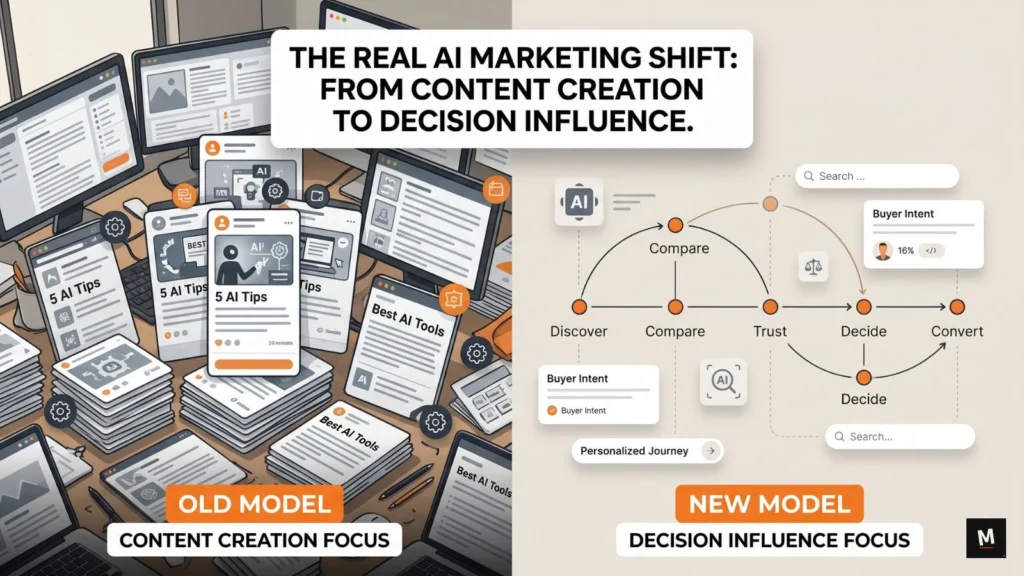
The real shift in AI marketing is not content creation.
The real shift is decision influence.
AI is changing how people discover options, compare brands, understand services, trust businesses, and decide who to contact. That means the old idea of “publish more content and wait for traffic” is becoming weak.
The question is no longer:
“How much content can we create with AI?”
The better question is:
“Can our content help a buyer make a better decision when AI systems are shaping the discovery process?”
That is where AI marketing is moving.
And most businesses are still stuck at the wrong layer.
AI Marketing Is No Longer Only About Producing Content
For the last few years, most businesses treated AI like a content machine.
They used it to write:
- blog posts
- LinkedIn posts
- cold emails
- ad copy
- product descriptions
- landing page sections
- captions
- newsletters
There is nothing wrong with that.
AI can support content production.
But content production alone is not marketing strategy.
A business can publish 100 AI-generated posts and still fail to create trust. It can fill its blog with articles and still not become the preferred choice. It can generate more emails and still attract low-quality leads.
This is already visible.
A widely discussed AI content experiment covered by Sword and the Script looked at 2,000 AI-generated articles across multiple new websites. The result was weak. The sites generated very low traffic compared to the amount of content published.
The issue was not only AI.
The issue was that the content had no real authority, no strong point of view, no proof, no brand memory, no internal structure, and no reason for someone to trust it.
That is the warning.
AI can help you produce content faster.
But if the content does not help buyers understand, compare, trust, or decide, it becomes noise.
The Buyer Journey Is Moving Into AI-Assisted Surfaces
The buyer journey used to be simpler.
A user searched on Google, clicked a few websites, compared options manually, checked reviews, and contacted a business.
Now the journey is changing.
Users are asking AI systems for help before they visit websites.
They ask:
- Which service is better for my situation?
- What should I compare before hiring?
- Which brand looks more trustworthy?
- What questions should I ask a consultant?
- What are the risks?
- What are the common mistakes?
- Which option fits my budget?
- Which provider seems more credible?
This matters because AI is no longer just answering basic questions.
AI systems are becoming discovery and decision layers.
OpenAI has already pushed ChatGPT deeper into product discovery through its product discovery experience in ChatGPT. Users can explore, compare, and evaluate options inside the conversation.
Google is also moving in the same direction. In its 2026 commerce direction, Google explained that search is becoming more conversational, visual, assistive, and action-oriented through AI Mode and AI-powered commercial experiences. You can read Google’s official direction here: What to expect in digital advertising and commerce in 2026.
This is not only a retail shift.
It is a marketing shift.
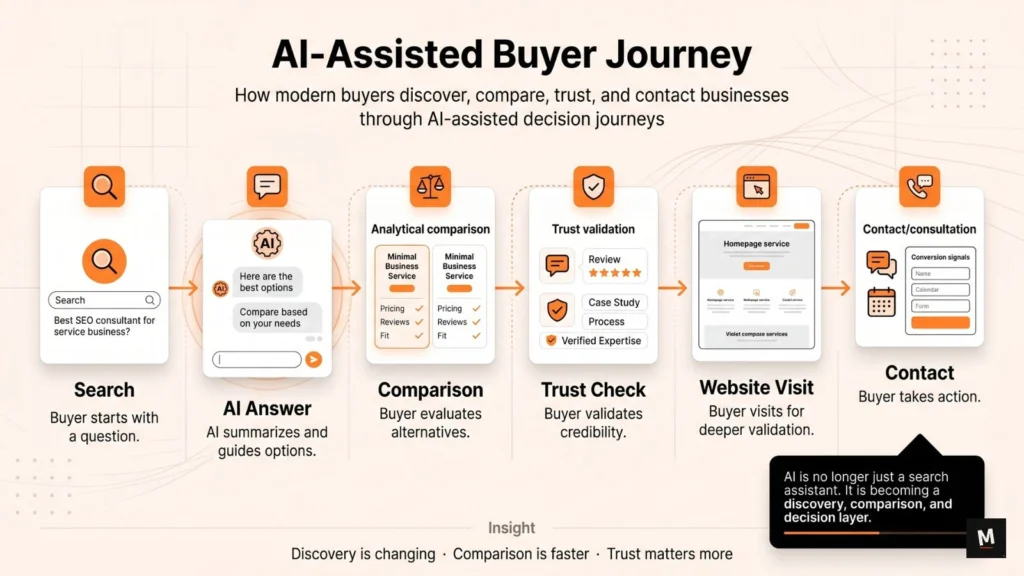
When AI systems become the place where buyers ask questions, compare options, and make early decisions, your website content has a new job.
It must help AI understand:
- who you are
- what you do
- who you help
- what problem you solve
- how your process works
- why you are credible
- what makes you different
- what proof supports your claims
- when you are the right fit
- when you are not the right fit
That is why I already explained in AI Search Visibility for Service Businesses that indexing alone is not enough anymore.
Your content needs clarity.
Your service pages need structure.
Your proof needs to be visible.
Your positioning needs to be specific.
Otherwise, AI systems may understand your competitors better than they understand you.
Content Creation vs Decision Influence
Most businesses are still measuring the wrong thing.
They ask:
- How many blogs did we publish?
- How many posts did we create?
- How many emails did we send?
- How many prompts did we automate?
These are activity metrics.
They do not prove influence.
Decision influence is different.
Decision influence means your content helps a buyer move from confusion to clarity.
It helps them answer:
- Is this service relevant for me?
- Can I trust this business?
- Do they understand my problem?
- Do they have a clear process?
- Do they have proof?
- Are they better suited than other options?
- What should I do next?
This is the real marketing layer AI is exposing.
Here is the difference:
| Old AI Marketing Thinking | New AI Marketing Thinking |
|---|---|
| Use AI to create more content | Use AI to understand buyer decisions |
| Publish more articles | Build clearer decision-support pages |
| Chase content volume | Build topical and service clarity |
| Automate generic outreach | Personalize based on buyer context |
| Write broad explainers | Answer specific buyer questions |
| Focus on traffic only | Focus on trust, relevance, and conversion |
| Treat AI as a writing tool | Treat AI as a research, clarity, and decision-support tool |
This does not mean content is dead.
It means weak content is dead.
Content still matters, but only when it improves understanding, trust, comparison, or action.
Why This Matters More for Service Businesses
This shift is especially important for service businesses.
A product can sometimes sell through features, reviews, and pricing.
But a service is different.
A buyer needs to trust the person, the process, the thinking, and the outcome.
For example, if someone is looking for an SEO consultant, interior designer, marketing strategist, consultant, or boutique agency, they are not only buying a task.
They are buying judgment.
They want to know:
- Does this person understand my business?
- Will they protect my brand quality?
- Can they explain the process clearly?
- Do they know what matters?
- Are they practical or just using buzzwords?
- Can they improve results without making the brand look cheap?
That is why premium service businesses cannot win with generic AI content.
A premium interior design studio, for example, does not need 100 generic blogs about “home design tips.”
It needs clear service pages, project proof, location relevance, process clarity, comparison guidance, and trust-building content.
That is also why SEO for Interior Designers is not only about ranking keywords. It is about helping premium design studios become clearer, more visible, and more trustworthy in search.
The same logic applies to AI marketing.
If AI systems are helping buyers compare options, then your content needs to make your value easy to understand.
The Real Job of AI Marketing in 2026
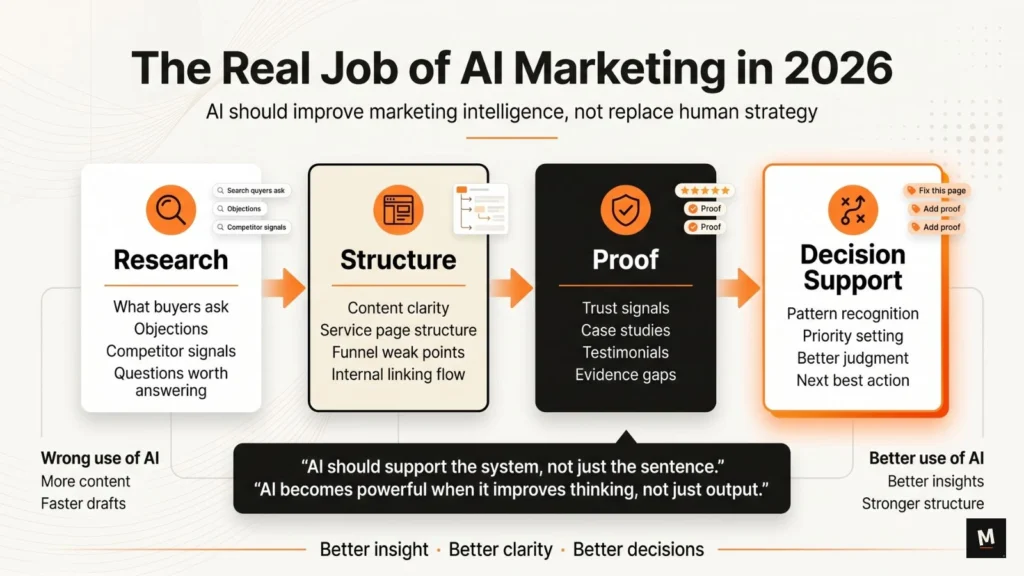
The real job of AI marketing is not to replace human strategy.
The real job is to improve marketing intelligence.
AI should help you understand:
- what buyers are asking
- what objections stop them
- what competitors are saying
- where your content is unclear
- which pages lack proof
- where your funnel is weak
- which questions deserve dedicated answers
- which service pages need better structure
- which internal links should support decision flow
This is where AI becomes useful.
Not as a shortcut for thinking.
As a tool for better thinking.
For example, AI can analyze your service pages and tell you where your offer is unclear. It can compare your page with competitors and identify missing trust signals. It can extract buyer questions from reviews, sales calls, Reddit threads, Quora answers, and search queries.
But the final judgment still needs a human.
AI can show patterns.
You decide what matters.
That is the difference between using AI as a content machine and using AI as a decision-support system.
I covered a related idea in Agentic AI in Marketing, where the focus moves beyond single prompts and into workflows that research, analyze, act, and improve.
Google has also been discussing how AI agents are moving beyond simple answers and into more practical workflows. Their official post on how AI agents will transform work in 2026 shows the direction clearly: AI is becoming more operational, not just conversational.
For marketers, that means AI should support the system.
Not just the sentence.
The 4C Framework for Decision-Focused AI Marketing
If you want to use AI marketing properly, think in four layers.
1. Clarity
AI systems cannot understand a business that cannot explain itself.
Your website should clearly answer:
- What do you do?
- Who do you help?
- What problem do you solve?
- What is your process?
- What outcome can someone expect?
- What makes you different?
- What should the visitor do next?
This is why source-of-truth content matters.
A source-of-truth page is a page that clearly defines your service, audience, positioning, process, proof, and next step.
I explained this deeper in Source of Truth for AI Search. If your website does not clearly define your business, AI systems may build an incomplete or inaccurate understanding of you.
For service businesses, clarity is not a design issue only.
It is a visibility issue.
2. Credibility
AI-assisted discovery rewards trust signals.
Not always directly in a simple ranking-factor way, but practically.
If your site has no proof, no author clarity, no examples, no case studies, and no real business context, it becomes harder for both humans and AI systems to trust your content.
Credibility can come from:
- case studies
- client examples
- before-after proof
- process explanation
- founder experience
- testimonials
- industry focus
- real screenshots
- original insights
- clear contact information
- consistent brand presence across the web
This is also connected to lead quality.
When your website is vague, you attract vague leads.
When your website is specific, you attract better-fit leads.
That is why AI Lead Generation Without Killing Lead Quality is important. AI can generate more leads, but if your positioning and qualification are weak, it can also increase noise.
3. Comparison
Buyers compare before they contact.
AI makes comparison easier.
That means your content should support comparison instead of hiding from it.
Create content that answers:
- How is this service different from alternatives?
- When should someone choose this option?
- When should someone not choose it?
- What does the process include?
- What affects pricing?
- What mistakes should buyers avoid?
- What questions should they ask before hiring?
This is where many service businesses are weak.
They only write service pages.
They do not create decision-stage content.
For example, an interior design studio can publish:
- Interior designer vs decorator: what is the difference?
- How to choose an interior designer for a luxury home
- What should be included in an interior design proposal?
- How much does premium interior design cost?
- Questions to ask before hiring an interior designer
- Why beautiful websites still do not rank for interior designers
These are not random blogs.
They support buyer decisions.
4. Conversion
Decision influence is incomplete without conversion clarity.
If your content educates but does not guide the next action, it loses business value.
Every important page should answer:
- What should the reader do next?
- Is this for them?
- What happens after they contact you?
- What is the entry offer?
- What is the risk of delaying?
- What is the expected outcome?
For MayankUnfiltered, the practical entry point is the SEO Visibility Sprint.
That sprint fits the decision-influence model because it is not a vague retainer pitch. It gives service businesses a focused way to diagnose visibility, clarity, structure, and search readiness before committing to long-term SEO.
How AI Changes the Customer Journey
The customer journey is no longer a clean funnel.
It is messy.
A buyer may:
- ask ChatGPT for options
- search Google for examples
- check LinkedIn for credibility
- read a comparison article
- visit the website
- go back to AI for questions
- compare pricing
- ask for recommendations
- check reviews
- contact only one or two businesses
This means your content cannot exist in isolation.
Your blog posts, service pages, About page, case studies, FAQs, and social presence all contribute to how your business is understood.
That is why AI Customer Journey Mapping 2026 is a relevant supporting topic. AI-assisted journeys require better content mapping because buyers are not moving in a straight line.
They are moving through questions.
Your content should answer those questions at the right depth.
Example: A Premium Interior Design Studio
Imagine a premium interior design studio with a beautiful website.
The visuals are strong.
The portfolio is attractive.
But the site does not rank well, and it does not explain the business clearly.
The homepage says:
“We create timeless luxury spaces.”
That sounds nice.
But it does not answer:
- Which cities do they serve?
- Do they handle full home interiors?
- Do they work with villas, apartments, offices, or retail spaces?
- What is their process?
- What budget level do they work with?
- What makes them different?
- What proof do they have?
- How long does a project take?
- What should a client expect before contacting them?
Now imagine a buyer asks AI:
“Which interior designer should I hire for a luxury villa in Bangalore?”
If the studio’s website lacks clarity, AI has less useful information to work with.
A competitor with clearer pages, better service structure, location relevance, project proof, and helpful comparison content may become easier to recommend.
That is decision influence.
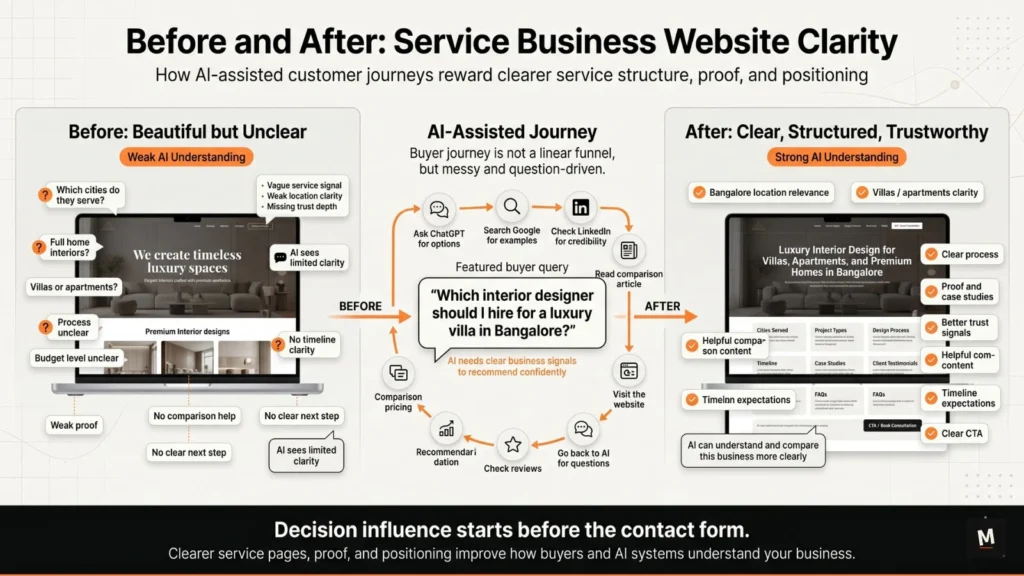
It starts before the contact form.
Where Query Fan-Out Fits Into This Shift
AI search systems do not always answer from one simple keyword.
They often break a query into related sub-questions.
This is called query fan-out.
For example, a user may ask:
“Best SEO consultant for premium interior designers.”
An AI system may need to understand related subtopics like:
- SEO consultant experience
- premium service business SEO
- interior designer SEO
- local SEO
- portfolio visibility
- service page optimization
- trust signals
- pricing intent
- business location
- reviews and proof
This is why single-page keyword stuffing is weak.
You need a connected content ecosystem.
I explained this in more detail in Query Fan-Out SEO for Service Businesses.
For AI marketing, the lesson is simple:
Your content should not only target one keyword.
It should support the wider decision path around that keyword.
What Businesses Get Wrong About AI Marketing
Most AI marketing mistakes come from treating AI as a shortcut.
Here are the most common mistakes.
Mistake 1: Publishing More Without Saying Anything New
AI can create content that sounds polished but says nothing original.
That is dangerous.
If your content repeats what every competitor says, it will not build authority.
A serious buyer can feel generic content.
AI systems can also detect weak topical structure when content has no depth, no supporting pages, and no clear entity signals.
Mistake 2: Using AI for Spam Instead of Relevance
AI can scale outreach.
But bad outreach at scale is still bad outreach.
If you use AI to send generic cold emails, generic LinkedIn messages, and generic follow-ups, you may increase activity but reduce trust.
Marketing is not only about reaching more people.
It is about reaching the right people with the right context.
Mistake 3: Ignoring Website Structure
Many businesses use AI to create content but ignore the foundation.
Their service pages are weak.
Their internal links are random.
Their About page is generic.
Their case studies are missing.
Their CTAs are unclear.
Their content does not connect back to revenue pages.
That is why AI content alone does not solve visibility.
You need structure.
Mistake 4: Chasing Tools Instead of Building Systems
A new AI tool launches every week.
That does not mean every business needs every tool.
A practical AI marketing system is more valuable than a messy tool stack.
Start with:
- research workflow
- content brief workflow
- editing workflow
- internal linking workflow
- lead qualification workflow
- reporting workflow
- decision-stage content workflow
I explained this operational angle in AI Marketing Workflow for Small Businesses.
Mistake 5: Forgetting the Human Buyer
AI can summarize.
AI can recommend.
AI can compare.
But the final buyer still needs trust.
This is where brand voice, proof, judgment, and clarity matter.
AI can help you reach the buyer.
But your thinking still needs to convince them.
Practical AI Marketing Checklist for Service Businesses
Use this checklist before creating more AI content.
Website Clarity
- Is your core service clearly defined?
- Is your target audience clear?
- Is your location or market context clear?
- Is your process explained?
- Is your outcome explained?
- Is your CTA obvious?
Trust Signals
- Do you show proof?
- Do you have testimonials?
- Do you show case studies or examples?
- Do you have an author or founder identity?
- Do you explain your experience?
- Do you avoid vague claims?
Decision Content
- Do you answer buyer objections?
- Do you compare options?
- Do you explain pricing factors?
- Do you show who the service is for and not for?
- Do you help buyers make a better decision?
AI Search Readiness
- Are your pages structured with clear H2s and H3s?
- Do your blogs internally link to relevant service pages?
- Do your service pages link to supporting blogs?
- Do you use schema where it makes sense?
- Do you have source-of-truth pages?
- Do related topics support each other?
Conversion Readiness
- Is there a clear next step?
- Is the CTA aligned with the reader’s stage?
- Do you offer a low-friction entry point?
- Do you explain what happens after contact?
[VISUAL SUGGESTION: Add checklist visual here]
Visual title: AI Marketing Decision Influence Checklist
Suggested alt text: Checklist for service businesses to improve AI marketing through clarity, trust, decision content, AI search readiness, and conversion readiness.
How to Use AI Without Becoming Generic
The smartest use of AI in marketing is not “write this blog.”
The smarter use is:
- analyze this buyer journey
- find gaps in this service page
- identify missing trust signals
- compare our positioning with competitors
- turn customer objections into content topics
- summarize sales call patterns
- generate FAQ ideas based on buyer intent
- suggest internal links between related pages
- convert case study data into decision-stage content
- create content briefs based on real search intent
Then a human strategist should decide what to publish.
This is how AI supports quality.
AI should help you think faster.
It should not replace thinking.
If you are new to the broader concept, you can start with What Is AI Marketing? or the broader AI Marketing Guide. But for a serious business, the next step is not learning definitions.
The next step is applying AI to visibility, clarity, and decision-making.
What This Means for SEO
AI marketing and SEO are becoming more connected.
Traditional SEO focused heavily on:
- keywords
- backlinks
- technical structure
- content quality
- internal links
- search intent
- rankings
These things still matter.
But AI search adds another layer.
Now your content also needs to be:
- easy to summarize
- easy to compare
- easy to trust
- easy to cite
- easy to connect with related entities
- easy to understand as a source of truth
This is why AI Overviews for Marketers and SEO Content Teams is an important topic.
AI Overviews, AI Mode, ChatGPT discovery, and other answer systems are changing how visibility works.
You are not only competing for rank.
You are competing for inclusion, understanding, and trust.
That means content structure matters more.
Entity clarity matters more.
Internal linking matters more.
Proof matters more.
Topical authority matters more.
And generic content becomes weaker.
What to Watch Next
The next phase of AI marketing will likely move in three directions.
1. AI Discovery Will Become More Commercial
ChatGPT and Google are already moving toward richer discovery experiences.
OpenAI’s product discovery push and Google’s AI Mode direction both show that users will increasingly compare and evaluate options inside AI-powered interfaces.
For service businesses, this means your content should be ready for AI-assisted research, not just traditional search clicks.
2. AI Agents Will Handle More Tasks
AI agents are moving beyond answers and into actions.
They will support workflows like research, comparison, scheduling, qualification, buying, and follow-up.
This means businesses need cleaner data, clearer processes, and better structured content.
If your business logic is scattered across random pages, PDFs, and vague service descriptions, AI agents will struggle to understand it.
3. Trust Will Become a Stronger Differentiator
As more businesses use AI, content sameness will increase.
Trust will become the separator.
The businesses that win will not be the ones publishing the most.
They will be the ones that are clearest, most credible, and easiest to understand.
Key Takeaways
AI marketing is not just about creating more content.
It is about influencing the buyer’s decision journey.
The old model was:
Create content → get traffic → hope for leads.
The new model is:
Create clarity → build trust → support comparison → influence decisions → convert better-fit buyers.
That is the shift.
If your business uses AI only to publish more, you may create more noise.
If you use AI to understand buyers, strengthen service pages, build proof, improve internal linking, and support decision-stage content, you create a real advantage.
For service businesses, this matters even more.
A service is not bought only through information.
It is bought through trust.
And in the AI-assisted search era, trust starts before the buyer reaches your website.
FAQs
How is AI changing marketing strategy?
AI is changing marketing strategy by moving influence earlier in the buyer journey. Buyers now use AI systems to discover, compare, summarize, and shortlist businesses before contacting them. This means marketing needs clearer service pages, stronger proof, better content structure, and decision-stage content, not just more content volume.
Is AI marketing only about content creation?
No. AI marketing includes content creation, but that is only one layer. The stronger use of AI is in research, buyer journey analysis, personalization, lead qualification, content structure, and decision support.
Why is generic AI content weak?
Generic AI content is weak because it often repeats existing information without original insight, proof, experience, or clear positioning. It may look polished, but it does not create trust or differentiation.
What should service businesses do differently with AI marketing?
Service businesses should use AI to improve clarity, trust, and decision support. They should audit service pages, identify buyer questions, create comparison content, add proof, improve internal linking, and structure pages so both humans and AI systems can understand them.
Does AI marketing replace SEO?
No. AI marketing does not replace SEO. It expands the role of SEO. Search visibility now includes traditional rankings, AI Overviews, conversational search, answer engines, and AI-assisted discovery. SEO still matters, but it needs stronger clarity, structure, and trust signals.
How can a business prepare for AI search visibility?
Start by making your core pages clear. Define your services, audience, process, proof, pricing factors, FAQs, and next steps. Then build supporting content around buyer questions and link everything contextually. You can also explore SEO Consulting for Premium Service Businesses if you want a strategy-led approach.
Conclusion
AI has made content creation easier.
But easier does not always mean better.
The real opportunity is not to publish more average content.
The real opportunity is to use AI to understand buyers better, structure your website better, answer decision-stage questions better, and make your business easier to trust.
That is the new AI marketing shift.
From content creation to decision influence.
Businesses that understand this will build better visibility, better trust, and better leads.
Businesses that ignore it will keep producing content that looks active but does not move buyers.
For premium service businesses, the next step is simple:
Do not start with more content.
Start with clarity.
Then build proof.
Then create decision-stage content.
Then use AI to improve the system.
That is how AI marketing becomes useful.
Not noisy.
Not generic.
Useful.
If your service business needs a focused visibility and clarity review, explore the 14-Day SEO Visibility Sprint. It is built for businesses that want to improve search visibility without turning their website into cheap SEO clutter.