AI Overviews are forcing a reset in how content works in search. This is not just another SERP feature update. It changes how users get answers, how brands earn visibility, and how content teams should think about traffic, authority, and usefulness.
Too many people still frame this as a simple SEO threat: rankings down, clicks down, traffic down. That view is too narrow. The real shift is bigger. AI Overviews filter low-value content faster and reward clarity, trust, synthesis, and actual usefulness.
Here is what AI Overviews mean for marketers, SEO teams, and content teams, and what smart teams need to change now.
What Are AI Overviews, Really?
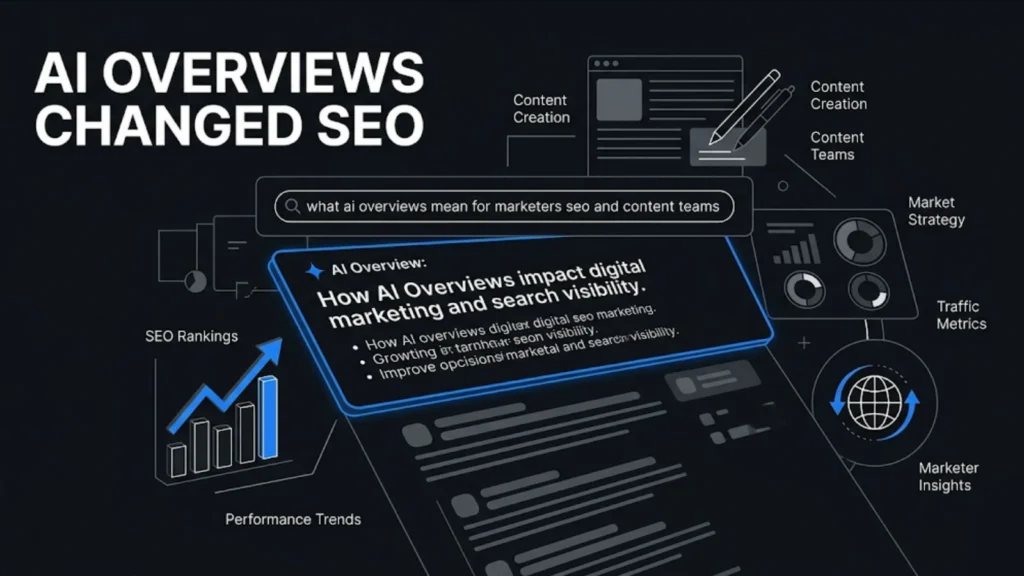
AI Overviews are AI-generated summaries that appear directly in Google search results for selected queries. Instead of showing only blue links, Google may generate a response that pulls together information from multiple sources and presents it upfront.
That is the basic definition. The more useful way to think about them is this:
AI Overviews are a new answer layer between the query and the click.
That matters because they change user behavior. A search result is no longer just a list of pages competing for attention. Google may now do part of the interpretation work itself. In many cases, the user gets enough context before deciding whether to click at all.
This is why AI Overviews matter beyond rankings:
- they change how visibility works
- they change what type of content gets clicked
- they increase pressure on generic informational content
- they make brand trust and source quality more important
So yes, this is part of the Google AI Overviews and SEO conversation. But it is not only about SEO mechanics. It is about content value inside a search environment that is becoming more selective.
Why AI Overviews Are More Than Just an SEO Update
A lot of teams are still treating AI Overviews like a technical ranking issue. That is too narrow.
The bigger change is search behavior.
For years, many content strategies were built on a simple model: identify informational keywords, publish pages around them, rank, and capture clicks. That model already had weaknesses, but AI Overviews expose them more clearly.
Here is what is changing.
Search visibility and traffic are no longer the same thing
A page can still rank and still get fewer clicks. Why? Because the user may see the summary first, get the basic answer, and move on.
This is one of the biggest shifts in the AI Overviews impact on SEO discussion. Teams that only track rankings will miss what is actually happening. Search impressions may stay healthy while traffic weakens. That means reporting has to mature.
Informational content faces more pressure
The pages most exposed are usually the ones offering surface-level explanations. Generic “what is,” “benefits of,” and “how it works” pages are easier for AI systems to summarize.
If your content adds little beyond a clean definition and a few common points, it is easier to remove from the click path.
The old publishing logic gets weaker
Many teams relied on scale. More blogs, more keywords, more chances to rank. That worked when basic coverage could still pull traffic. Now, that same volume-first model can leave you with a large content library and very little differentiation.
AI Overviews are making weak content strategies easier to expose.
What AI Overviews Mean for Marketers
For marketers, this is not just about lost organic clicks. It is about how brand presence works in search.
Brand visibility now has a new layer
A brand no longer competes only for a traditional ranking position. It also competes to be part of the source pool shaping AI-generated answers.
That means your content is doing more than chasing traffic. It is helping build brand familiarity, trust, and topical relevance across the search ecosystem.
Content needs a stronger purpose
A lot of marketing teams produced content because content was supposed to drive awareness. But awareness content without distinct value is less reliable now.
Marketers need to ask:
- Is this content giving a perspective, not just repeating basics?
- Does it help the reader make a decision?
- Does it strengthen the brand’s credibility in a category?
- Does it connect to a broader demand generation or trust-building goal?
The “just publish more blogs” mindset is getting weaker because search is becoming harsher on undifferentiated output.
Authority is not only about volume
A brand that consistently publishes sharp, useful, experience-backed content is in a better position than a brand flooding search with average explainers.
This is where AI Overviews become a strategic issue for marketers. Content systems now need to support:
- entity clarity
- consistent point of view
- better editorial standards
- stronger alignment between content and business positioning
What AI Overviews Mean for SEO Teams
SEO teams cannot operate with a purely keyword-first model anymore. Keywords still matter, but they are not enough.
Keyword targeting has limits now
A page built only to match a query pattern is easier to replace with an AI-generated summary. Surface-level optimization alone will not create durable value.
SEO teams need to shift from:
- “Can we rank for this keyword?”
to:
- “Can we create something worth surfacing, citing, and clicking?”
That is a different standard.
Topical authority matters more
Google needs confidence in who you are, what you cover, and why your pages deserve trust. Topical authority is not a buzzword here. It becomes more practical when AI systems need reliable sources to synthesize from.
Strong topical authority comes from:
- focused topic clusters
- semantic consistency
- strong internal linking
- clear subject ownership
- content depth across related queries
Entity clarity matters more too
If your brand, experts, products, or site themes are unclear, you are harder to trust and easier to ignore. SEO now overlaps more with brand clarity than many teams want to admit.
SERP ownership needs a broader mindset
Winning in search used to mean ranking first. Now it means occupying more useful positions across the search journey:
- being visible in core rankings
- appearing in source consideration
- supporting brand recall
- owning adjacent queries in a cluster
- capturing decision-stage clicks, not just awareness-stage impressions
That is the real AI Overviews and organic traffic challenge. Not all traffic is equal anymore. Teams need to focus more on valuable clicks, not just available clicks.
What Content Teams Need to Change Now
This is where the shift becomes operational.
The discussion around AI Overviews for content teams should not stop at “write better content.” That advice is too vague to be useful. Content teams need to change both what they create and how they create it.
Generic explainers will struggle more
If your article looks like every other article on page one, AI Overviews can compress its value into a summary more easily. That means basic explainers need stronger differentiation.
Original input matters more
You do not need to turn every article into a research paper. But you do need some form of information gain. That could be:
- firsthand experience
- sharper frameworks
- stronger synthesis
- original examples
- clearer comparisons
- better decision-making support
Brief quality needs to improve
Weak briefs create weak articles. If the brief only includes a keyword and a target word count, the output will likely be replaceable.
Strong briefs should include:
- search intent
- angle
- audience problem
- what to avoid
- what to include
- differentiation points
- internal linking context
- business relevance
Editing matters more than ever
AI-assisted writing can speed up drafting, but loose editing creates content that feels flat, repetitive, and generic. Content teams need tighter editorial control, sharper structure, and stronger sentence-level clarity.
What to Stop Doing
This is where most teams need honesty.
Stop publishing generic top-of-funnel fluff
If the page says what everyone else says, with no useful framing, it is weak content no matter how clean the on-page SEO looks.
Stop relying only on search volume
A keyword with volume is not automatically a good opportunity. If the result is increasingly answered inside Google, the traffic potential may be weaker than it looks.
Stop writing repetitive definitions
Not every article needs a long, padded definition section. Readers want progress. AI Overviews also make bloated intros and repetitive basics even less useful.
Stop creating no-differentiation content
If the article has no unique insight, no better structure, no sharper perspective, and no practical value, it is content for the sake of content.
Stop blind AI content scaling
AI can increase output. It can also multiply mediocrity. Scaling weak content faster does not create authority. It just fills your site with pages that struggle to earn attention.
What to Start Doing
If the old model is getting weaker, what replaces it?
Start publishing opinionated but useful content
Not empty opinions. Useful opinions. That means taking a stance, backing it with logic, and helping the reader think better.
Start adding synthesis, not just summaries
The internet already has enough summary content. The better move is synthesis: combining ideas, comparing approaches, and simplifying what actually matters.
Start designing for information gain
Every page should answer this question: what is new or clearer here that the reader would not get from ten average articles?
Start building clusters, not isolated posts
Cluster-based publishing helps search engines understand your depth and helps users move through related questions. It also supports better internal linking and stronger topical authority.
Start matching content format to query intent
Some queries need a strategic guide. Some need a comparison. Some need a checklist. Some need a strong point of view. Content design should follow intent, not habit.
Start strengthening internal linking
Internal links are not just for crawl support. They shape context, distribute authority, and help both users and search engines understand how your content fits together.
How Smart Teams Should Adapt Their Workflow
The smartest response to AI Overviews is not panic. It is workflow improvement.
Improve the research process
Research should go beyond “top-ranking pages say this.” Teams should look at:
- what is being repeated everywhere
- what is missing from the conversation
- where user confusion still exists
- what angle the brand can own
That is how you avoid creating another copy of the existing SERP.
Raise the quality of content briefs
A better brief creates a better article. This is one of the fastest upgrades most teams can make.
A strong brief should clarify:
- who the article is for
- what problem it solves
- what the main argument is
- what sections must exist
- what weak patterns to avoid
- what business role the content plays
Bring in real perspective
That could come from internal experts, strategists, operators, sales teams, customer conversations, or firsthand experience. Real perspective makes content harder to commoditize.
Build a content refresh system
Old content should not sit untouched while search behavior changes around it. Teams need a process to review pages for:
- weak intros
- outdated framing
- low information gain
- weak internal linking
- thin practical value
Measure more than rankings
Rankings still matter, but they are not enough. Teams should also look at:
- click-through patterns
- engagement quality
- assisted conversions
- branded search growth
- content-to-lead relevance
- traffic by intent stage
This is the real answer to how AI Overviews affect content strategy. They force better measurement, better planning, and better editorial discipline.
Final Take: AI Overviews Are a Filter, Not the End
AI Overviews are not the end of SEO, content, or organic growth. They are a filter.
They make low-value content easier to bypass. They make generic publishing strategies weaker. They force marketers, SEO teams, and content teams to think more clearly about why a page exists and what real value it provides.
That is the right way to view the impact of AI Overviews on SEO. Not as a reason to panic, but as a pressure test.
The teams that lose will keep publishing interchangeable content and hope volume saves them.
The teams that win will build sharper systems, stronger briefs, clearer positioning, and content that actually deserves attention.
Less noise. More utility. That is the shift.
Actionable Takeaways
Here is what teams should do next:
- audit your informational content and identify pages with weak differentiation
- reduce generic awareness content that adds no new value
- upgrade content briefs before increasing publishing volume
- build tighter topic clusters around core themes
- add real perspective, examples, and synthesis into articles
- track clicks, engagement, and conversion relevance, not just rankings
- refresh older pages that rely too much on definitions and filler
- align content format more closely with search intent
If your team is still treating AI changes as just another SEO update, your content strategy is already behind.
Frequently Asked Questions
What are AI Overviews in Google Search?
AI Overviews are AI-generated summaries shown in Google search results for certain queries. They pull together information from multiple sources and present an answer directly on the results page.
How do AI Overviews affect SEO traffic?
They can reduce clicks on some informational queries because users may get enough context from the summary without visiting a page. That is why teams need to focus on differentiated content and higher-value search intent.
What do AI Overviews mean for content teams?
They mean content teams need to move away from generic, repetitive articles and create content with stronger clarity, synthesis, originality, and practical value.
Should marketers change their content strategy because of AI Overviews?
Yes. Marketers need to think beyond rankings and traffic volume. Content should now support brand authority, trust, query intent, and decision-making value more clearly.
Are AI Overviews bad for organic search?
Not by default. They are bad for weak, replaceable content. Strong content with real utility, better structure, and clearer perspective still has an important role in search.