Most service business websites are still built around one old SEO idea:
Choose one keyword.
Create one page.
Add the keyword in the title, headings, and content.
Wait for rankings.
That approach is not completely dead.
But it is no longer enough.
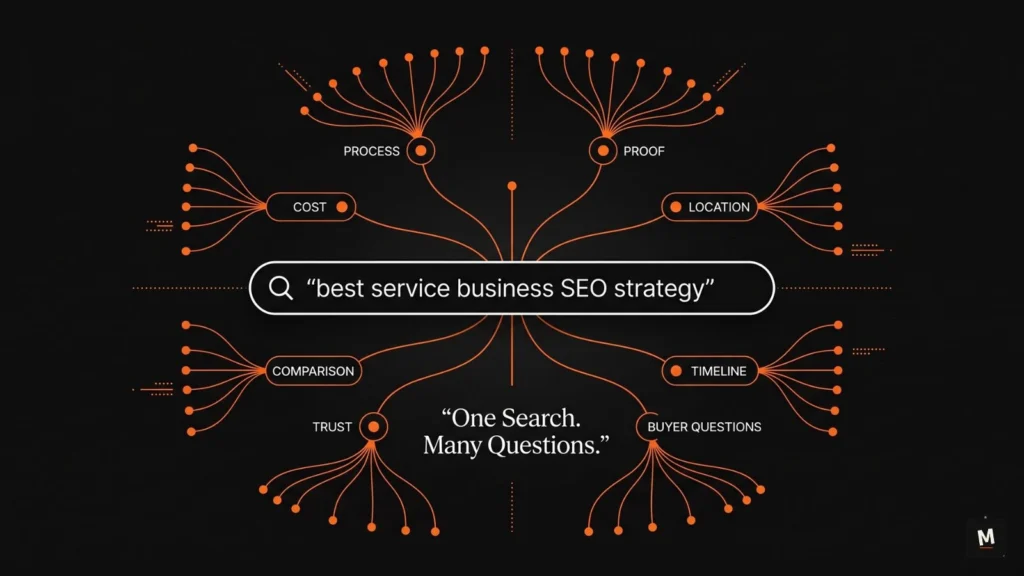
Search is moving from simple keyword matching to deeper question understanding. Google says AI Overviews and AI Mode may use query fan-out, where Search issues multiple related searches across subtopics and data sources to build a response. (Google for Developers)
That matters for service businesses.
Because a serious buyer does not search with one clean keyword in mind.
They search with doubts.
They compare options.
They check cost.
They look for proof.
They want to understand the process.
They want to know whether the business is credible enough to contact.
A service website that only targets one keyword may still miss the full buying context.
If your website only answers the main keyword, it may miss the hidden questions behind that keyword.
That is where query fan-out SEO becomes important.
What Is Query Fan-Out SEO?
Query fan-out SEO means optimizing your website for the wider set of related questions, subtopics, and buyer concerns behind one search query.
In simple words:
A user types one query.
But AI search may explore many related angles before building an answer.
Google explains that AI Mode uses query fan-out by dividing a question into subtopics and searching for each one across multiple data sources. (Google Help)
So instead of asking only:
What is the main keyword?
You also need to ask:
What related questions would search systems need to understand before giving a useful answer?
That is the real shift.
Simple example
A person searches:
best interior designer for luxury villa in Bangalore
A normal SEO approach may focus only on:
best interior designer in Bangalore
But query fan-out thinking goes deeper.
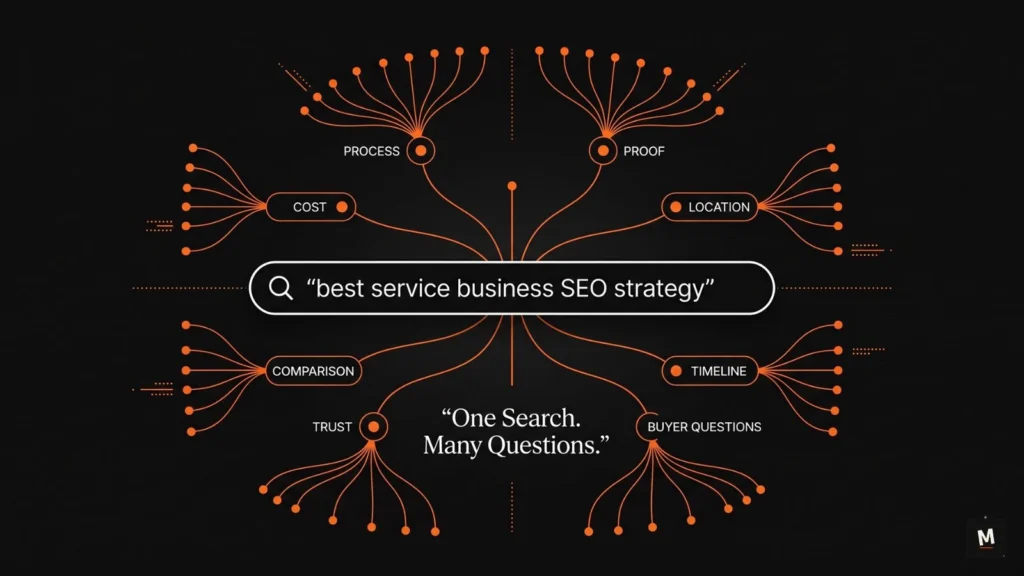
Search may also need to understand:
- luxury villa interior design cost
- villa interior design process
- portfolio quality
- location relevance
- design style
- timeline
- client proof
- material selection
- consultation process
- difference between an interior designer and a decorator
- project management capability
This means one service page may not be enough.
The website needs a stronger content structure around the service.
Why Keywords Are Still Useful, But Not Enough
Keywords still matter.
They show demand.
They show language.
They show how people describe problems.
They help you understand search intent.
But keywords are not the full strategy.
Weak SEO says:
Find keyword → write page → repeat keyword.
Stronger SEO says:
Understand buyer problem → map related questions → build useful pages → connect them properly.
That is the difference.
| Old Keyword SEO | Query Fan-Out SEO |
|---|---|
| Focuses on one main keyword | Covers the full buyer problem |
| Optimizes one page | Builds page plus supporting content |
| Answers surface-level intent | Answers visible and hidden intent |
| Depends mostly on ranking position | Builds answer-surface usefulness |
| Often creates thin service pages | Builds stronger service architecture |
A keyword can tell you what the buyer typed.
It cannot always tell you everything the buyer needs before taking action.
That is why service businesses need more than keyword placement.
They need topic coverage.
Why Query Fan-Out Matters More for Service Businesses
Service businesses do not sell simple products.
They sell trust.
A premium interior designer does not only sell design.
A consultant does not only sell advice.
A clinic does not only sell treatment.
A boutique agency does not only sell execution.
They sell judgment, process, confidence, quality, and outcome.
That means the buyer has more questions before contacting them.
For a service business, the hidden buyer questions often look like this:
- Can I trust this business?
- Do they understand my type of project?
- What does the process look like?
- What will it cost?
- What makes them different?
- Do they have proof?
- Are they right for my location?
- Will the result feel premium or cheap?
- What happens after I contact them?
- How do I know they are not generic?
This is why AI search visibility for service businesses cannot depend only on indexing.
Indexing means your page is available.
Visibility means your page is clear, useful, trusted, and relevant enough to be surfaced in the right context.
Why does query fan-out matter for service businesses?
Query fan-out matters because service buyers do not make decisions from one keyword. They compare expertise, process, proof, cost, location, and trust before taking action.
If your website does not cover these points clearly, it becomes weaker for both human decision-making and AI search understanding.
The Thin Service Page Problem
Many service websites have one main service page that says almost the same thing as every competitor.
Usually, the page says:
- we offer this service
- we have experience
- we provide quality work
- here are some benefits
- contact us today
That is not enough.
A thin service page may target a keyword, but it does not build enough clarity around the buyer problem.
It does not explain:
- who the service is for
- what problem it solves
- how the process works
- what the buyer should expect
- what makes the business credible
- what proof supports the claim
- what related questions the buyer has
- why this business is a better fit than another option
This creates a visibility gap.
A thin service page does not only hurt rankings. It weakens how clearly search systems understand your business.
If your website does not clearly explain your service, process, proof, and positioning, it becomes harder for search systems to treat it as a source of truth for AI search.
That is the real issue.
Most service businesses do not have only an SEO problem.
They have a clarity problem.
How Query Fan-Out Changes Content Strategy
Query fan-out does not mean you should publish random blogs every day.
That is the wrong lesson.
The right lesson is this:
Your content should support the buyer journey around your core service pages.
Start with the main service query.
Example:
SEO consultant for interior designers
Now break that into related buyer questions:
- Why do interior designers need SEO?
- Why is my interior design website not ranking?
- How can a premium design website rank without looking cluttered?
- What should be fixed before publishing more blogs?
- What pages should an interior designer website have?
- How should project pages be optimized?
- How does local SEO work for interior designers?
- How long does SEO take for design studios?
- What makes SEO different for premium service brands?
Each question can support the main service page.
This is not random blogging.
This is service-page support content.
Build supporting pages around real intent
Support content can include:
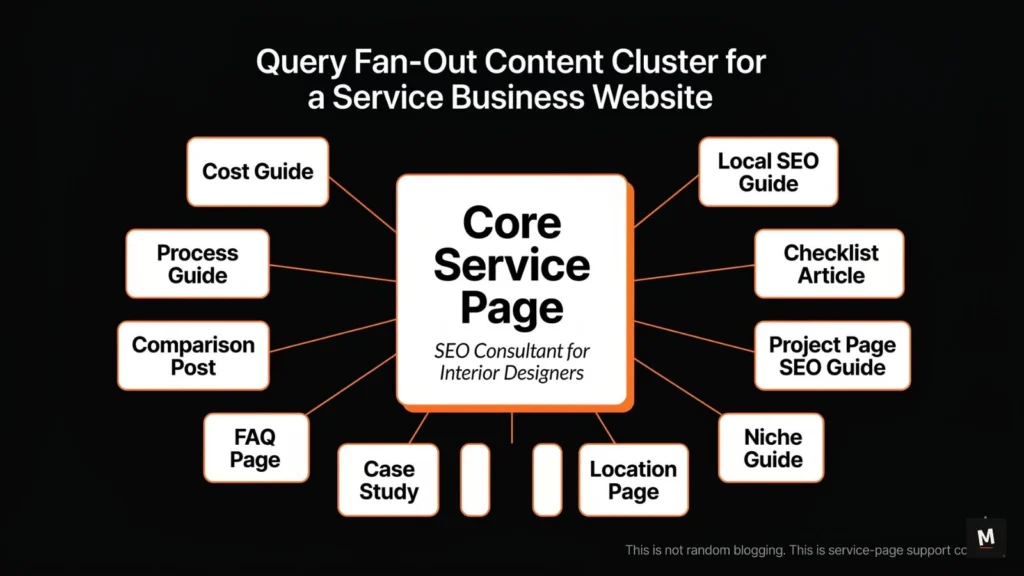
- problem-led guides
- comparison articles
- process explainers
- checklist articles
- niche-specific SEO pages
- FAQ-style resources
- case-study-style posts
- service decision guides
The goal is not to create more pages just because “more content is good.”
The goal is to make the website easier to understand across the full buyer journey.
Query Fan-Out SEO Framework for Service Business Websites
Query fan-out SEO becomes practical when you connect it to website structure.
Use this simple framework.
1. Define the core service page
Your main service page should not be vague.
It should clearly explain:
- what the service is
- who it is for
- what problem it solves
- what outcome it supports
- how the process works
- why the business is credible
- what the next step is
For premium service businesses, this is where SEO stops being only keyword work and becomes a strategic clarity problem.
That is exactly where SEO consulting for premium service businesses should focus: clearer website structure, stronger service positioning, and better search visibility.
2. Identify hidden buyer questions
Do not only ask:
What keyword should this page target?
Ask:
What does the buyer need to understand before trusting this business?
Look for questions around:
- cost
- process
- proof
- comparison
- timeline
- location
- mistakes
- expectations
- suitability
- credibility
These questions reveal the support content your website may need.
3. Build supporting content
Each support page should answer one meaningful question.
Not every article needs to sell directly.
Some articles build trust.
Some explain process.
Some reduce confusion.
Some support internal linking.
Some strengthen topical authority.
Some help the buyer move closer to action.
That is how content becomes useful.
Google’s helpful content guidance also supports this direction: content should be created to benefit people, not mainly to manipulate rankings. (Google for Developers)
4. Internally link back to the money page
Internal linking is not just an SEO trick.
It helps users and search systems understand how your content connects.
Google says links help Google find pages and understand relevance, while good anchor text helps people and Google make sense of the linked page. (Google for Developers)
Your support articles should naturally link back to the main service page.
Example anchors:
- SEO consulting for premium service businesses
- SEO for interior designers
- SEO visibility sprint
- service website SEO strategy
- AI search visibility for service businesses
But the anchor should fit the sentence.
Do not force it.
5. Strengthen trust signals
Query fan-out SEO is not only about content quantity.
Trust signals matter.
Your website should show:
- clear about page
- founder or expert context
- real examples
- process clarity
- portfolio or proof
- service-specific FAQs
- useful internal links
- relevant external references
- clear contact path
Query fan-out SEO is not about publishing more. It is about making your website easier to understand across the full buyer journey.
Example: Interior Designer SEO and Query Fan-Out
Let’s take a premium interior design website.
The main service keyword may be:
interior designer in Bangalore
Or:
luxury interior designer in Bangalore
But the buyer’s actual decision is not that simple.
They may also want to know:
| Buyer Question | Content/Page Needed |
|---|---|
| Why is my interior design website not ranking? | Problem-led SEO article |
| What pages should an interior design website have? | Website structure guide |
| How can project pages rank better? | Project-page SEO guide |
| How can SEO work without making the website look cheap? | Premium SEO positioning article |
| Do interior designers need local SEO? | Local SEO guide |
| What should be fixed before blogging? | SEO visibility audit/sprint page |
| How can portfolio pages bring better search visibility? | Portfolio SEO guide |
| How should location pages be structured? | Location SEO guide |
This is why SEO for interior designers cannot depend only on one service page.
Interior design buyers care about style, trust, location, budget, proof, and project confidence.
So the SEO structure should reflect that.
A premium design website should not become cluttered just to target keywords.
It should become clearer.
That is the difference between cheap SEO and strategic SEO.
What Service Businesses Should Fix First
Before writing 50 blogs, fix the core website.
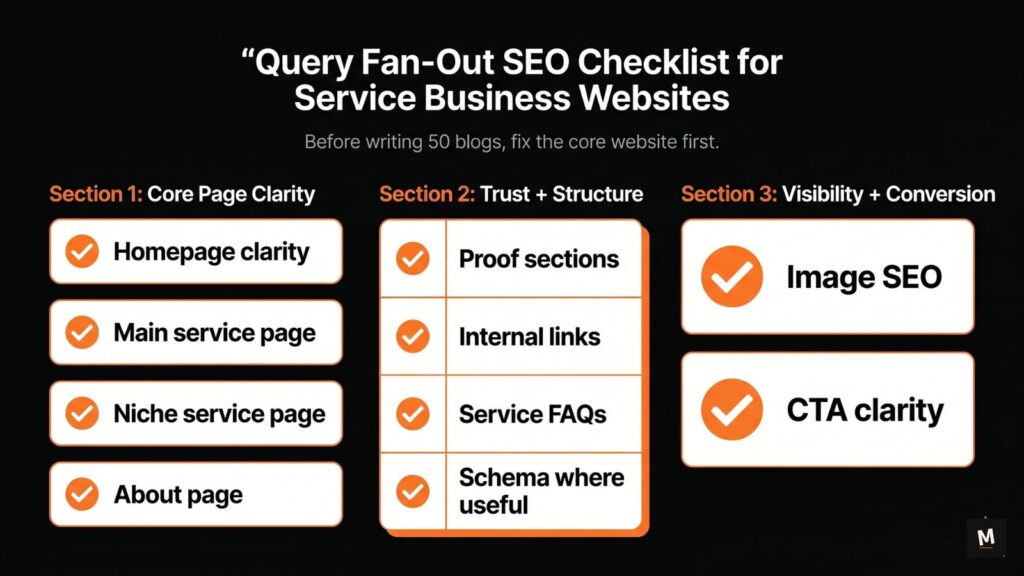
More content will not help much if the main pages are unclear.
Start here:
| Priority | Fix | Why It Matters |
|---|---|---|
| 1 | Homepage clarity | Helps visitors understand who you help and what you do |
| 2 | Main service page | Builds clear commercial relevance |
| 3 | Niche service page | Supports specific buyer intent |
| 4 | About page | Builds trust and credibility |
| 5 | Proof sections | Shows why the business should be trusted |
| 6 | Internal links | Connects related pages into a clear structure |
| 7 | Service FAQs | Answers buyer doubts |
| 8 | Image SEO | Helps visual and contextual understanding |
| 9 | Schema where useful | Supports structured understanding |
| 10 | CTA clarity | Turns visibility into action |
Most service businesses skip this.
They start publishing blogs while the homepage is unclear, the service page is thin, and the internal links are weak.
That is backwards.
The first job is not scale.
The first job is structure.
What Not to Do
Query fan-out SEO can easily be misunderstood.
Do not treat it as an excuse to mass-publish AI content.
That will create more noise, not more trust.
Avoid these mistakes:
- publishing random AI-written blogs
- targeting every keyword blindly
- making service pages bloated
- stuffing FAQs without real usefulness
- adding schema before fixing page clarity
- copying competitor topics without understanding buyer intent
- creating blogs that do not support any service page
- adding internal links mechanically
- writing generic “what is” content with no business angle
More content does not automatically create more visibility. Bad content creates more confusion.
This matters especially for premium service businesses.
A premium website should not feel like an SEO dump.
It should feel clear, useful, and intentional.
How Query Fan-Out Connects With AI Search Visibility
Query fan-out connects directly with AI search visibility because AI-style search experiences may pull from a wider set of supporting pages, not only the page that exactly matches the original query.
That means your website needs to be useful beyond one exact keyword.
This is also why AI Overviews for marketers and SEO content teams should be understood as a content quality and structure challenge, not just a ranking feature.
To become more visible in AI-style search, a service business website needs:
- clear service pages
- supporting content
- internal links
- proof
- structured explanations
- trustworthy references
- direct answers
- real expertise
You do not need to chase every AI trend.
But you do need to make your website easier to understand.
The Practical Takeaway
Query fan-out does not mean SEO is dead.
It means shallow SEO is weaker.
A service business website cannot depend only on one keyword and one service page anymore.
It needs:
- clearer service pages
- stronger support content
- better internal linking
- proof-led sections
- answer-ready formatting
- topic coverage around real buyer questions
- stronger trust signals
The goal is not to publish more content blindly.
The goal is to make your website useful across the full decision journey.
If your website already has service pages but no clear topic coverage around buyer questions, the first step is not publishing more blogs.
The first step is finding the visibility gaps through a focused SEO visibility sprint.
That is where the real work starts.
FAQs
What is query fan-out SEO?
Query fan-out SEO is the practice of covering the related subtopics, questions, and buyer concerns behind one main search query. Instead of optimizing only for one keyword, you build content that helps search systems understand the full topic.
Does query fan-out mean keywords are no longer useful?
No. Keywords are still useful because they show search demand and language. But keywords should guide topic coverage, not limit your strategy to one page and one phrase.
Why does query fan-out matter for service businesses?
It matters because service buyers ask layered questions before taking action. They want to understand process, cost, proof, trust, location, and suitability. A thin service page usually cannot answer all of that.
How can a service business optimize for query fan-out?
Start with the main service page. Then identify related buyer questions. Create supporting content around those questions. Internally link the content back to the core service page. Strengthen proof, process clarity, and trust signals.
Is query fan-out only important for Google AI Mode?
Query fan-out is strongly connected with Google AI Mode and AI Overviews, but the broader principle applies to AI search in general. Search systems are moving toward deeper topic understanding, not just exact keyword matching.
Should service businesses create more blogs for query fan-out SEO?
Only if those blogs support a real buyer question or a core service page. Random blogs will not help much. The content should strengthen clarity, trust, and decision-making.