Most small businesses are not struggling because they lack AI tools.
They are struggling because they do not have an AI marketing workflow.
One tool writes content. Another creates images. A third summarizes meetings. Something else helps with email. But none of it works as a system. The result is predictable: random output, inconsistent execution, weak follow-up, and no clear link between marketing effort and business outcome.
That is the real problem.
A lean AI marketing workflow is not about stacking 15 tools together. It is about building one simple operating system that connects research, content, distribution, lead capture, reporting, and optimization. When that flow is clear, AI becomes useful. When it is not, AI just creates more noise.
What Is an AI Marketing Workflow?
An AI marketing workflow is a structured process where AI supports key marketing activities in sequence instead of being used randomly.
It usually looks like this:
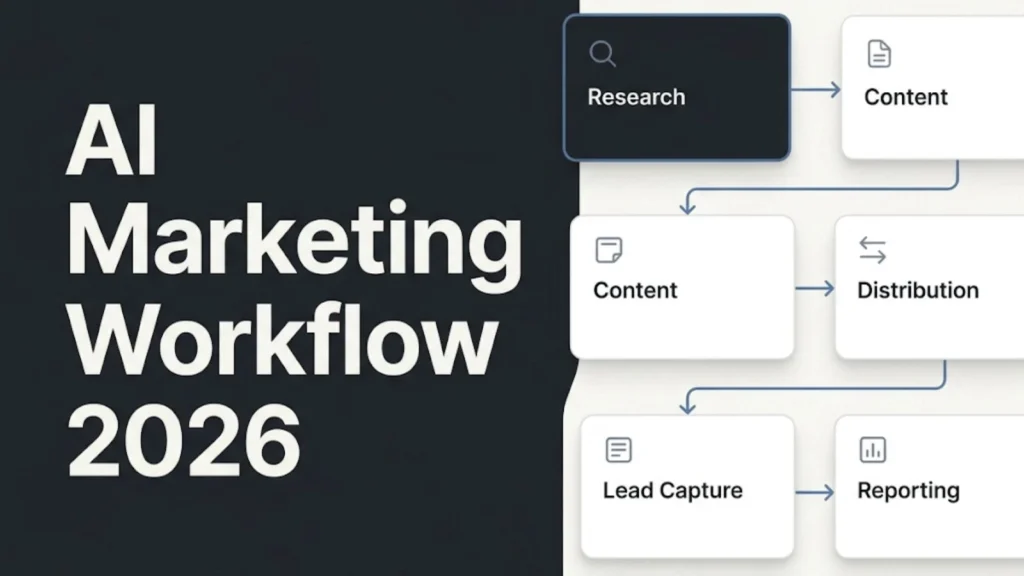
Research and idea validation → content creation → content distribution → lead capture and response → reporting and optimization
This matters because marketing does not happen in isolated tasks. A blog post is not just content. It should come from validated demand, get repurposed into distribution assets, move people toward an offer or capture point, and feed performance data back into the next cycle.
That is what a real AI marketing process looks like.
A proper AI workflow for marketing helps a small business do three things better:
- Reduce manual effort
- Increase speed of execution
- Improve consistency across the funnel
The goal is not to replace thinking. The goal is to remove low-value repetition so the business can focus on better decisions.
Why Most Small Businesses Fail With AI Marketing
Most small businesses fail with AI because they start with tools, not workflow.
They ask:
“What is the best AI tool for content?”
“What should I use for automation?”
“Which AI app is trending right now?”
These are the wrong starting questions.
The better question is:
“What are the repeatable marketing actions in my business, and where can AI reduce friction?”
Here is where most teams go wrong:
- They use AI for content but not for research
- They publish content but do not build distribution around it
- They collect leads but respond too slowly
- They track activity but not performance
- They create prompts but not systems
This is why small business AI marketing often becomes messy. AI increases output, but without structure, more output just creates more mess.
If your workflow is broken, AI amplifies the broken workflow.
Read More:- How to Start an AI Marketing Agency in 2026
The 5 Core Parts of a Lean AI Marketing Workflow
A lean AI marketing system for a small business should have five connected parts:
1. Research and idea validation
Use AI to identify what your audience is actually asking, searching, comparing, or struggling with.
2. First-draft content creation
Use AI to speed up rough drafting, outlining, summarizing, and structuring.
3. Content distribution
Use AI to turn one content asset into multiple channel-ready variations.
4. Lead capture and response
Use AI to improve follow-up, first response, qualification, and routing.
5. Reporting and optimization
Use AI to summarize weekly performance, spot patterns, and suggest next actions.
That is the backbone of practical AI marketing operations.
Now let’s break the workflow down step by step.
Step 1: Use AI for Research and Idea Validation
This workflow starts with validation, not writing.
Most small businesses waste time creating content around assumptions. AI helps reduce that waste by speeding up early-stage thinking.
Use AI here for:
- Topic clustering
- FAQ extraction
- Objection discovery
- Competitor angle analysis
- Search intent mapping
- Offer-message matching
For example, if you run a local service business, do not ask AI to “give blog ideas.” That is lazy input, and it usually leads to generic output.
Ask better questions instead:
- What are the top fears customers have before buying this service?
- What comparison-style topics show commercial intent?
- What content angles build trust before contact?
- What questions appear before someone is ready to convert?
The output of this stage should be a focused content and messaging list, not random inspiration.
If your research layer is weak, everything after it becomes guesswork.
Step 2: Use AI to Create First-Draft Content Faster
AI should not replace judgment. It should remove the friction of blank-page work.
This is where many businesses either overtrust AI or underuse it.
The right use is simple: let AI create the first draft faster, then improve it with human clarity, brand tone, and practical relevance.
At this stage, AI can help with:
- Article outlines
- First-draft blog sections
- Landing page structure
- Email draft variations
- Ad copy options
- FAQ generation
- Headline testing directions
The key is to use AI for structure and momentum, not final publishing by default.
A strong workflow looks like this:
- Give AI a validated topic
- Provide the search intent
- Define the audience
- Set the angle
- Generate the first draft
- Edit for accuracy, tone, clarity, and specificity
That is how AI marketing process execution becomes useful instead of robotic.
If you skip editing, your content becomes generic. If you skip AI, your output stays slow. The balance is where the real gain happens.
Step 3: Use AI to Repurpose Content for Distribution
This is where most businesses lose momentum.
They create one good piece of content, publish it once, then move on.
That is not a workflow. That is content waste.
A lean AI workflow for marketing treats every core content asset as a source asset. One blog, guide, video, case point, or insight should feed multiple channels.
AI can help turn one asset into:
- LinkedIn posts
- X threads
- Email snippets
- Short-form hooks
- Meta ad copy angles
- WhatsApp follow-up messages
- Sales enablement notes
- FAQ blocks for landing pages
This does two things: it reduces content fatigue and increases message consistency.
For a small business, this matters. You do not need endless new ideas. You need better reuse of the right ideas.
A simple rule works well:
Create once. Distribute five ways.
That one rule alone can improve the effectiveness of small business AI marketing more than adding another tool ever will.
Step 4: Use AI to Improve Lead Capture and Response Speed
Marketing does not stop at clicks or views. If the lead-handling process is weak, the workflow breaks right after attention is generated.
This is where many small businesses leak money.
They generate interest, but:
- Forms are weak
- Replies are delayed
- Lead quality is unclear
- Follow-up is inconsistent
AI can improve this part of the workflow by helping with:
- Better lead form questions
- Auto-drafted first responses
- Lead qualification logic
- FAQ replies
- CRM note summarization
- Follow-up sequence drafting
For example, if someone fills out a form asking about your service, your first reply should not depend on whether you “get time later.” A lean system should already have response logic ready.
The faster and clearer your first response, the better your conversion potential.
This is where your AI marketing system starts connecting marketing with sales. For many small businesses, this is where AI starts showing clear business value.
Step 5: Use AI for Weekly Reporting and Optimization
A lot of small business marketing fails because there is activity but no review loop.
Content gets published.
Posts go out.
Leads come in sometimes.
But nobody steps back and asks: What actually worked this week?
AI can make reporting faster by helping summarize:
- Traffic trends
- Top-performing content
- Lead source patterns
- Response time issues
- Drop-off points
- Channel-level performance notes
- Next-week optimization suggestions
This reporting layer should happen weekly, not randomly.
The point is not to build pretty dashboards for ego. The point is to create useful decision support.
A simple weekly reporting flow can include:
- What we published
- What reached people
- What got engagement
- What created leads
- What did not move
- What we should change next week
That is how AI marketing operations become practical. Without optimization, workflow turns into routine. With optimization, workflow becomes a growth system.
Read More:- AI Marketing in 2026: Complete Business Guide to Strategy, SEO, Content, and Ads
AI Marketing Workflow Example for a Small Business
Let’s say a small web design agency wants to use AI without creating chaos.
Here is a lean example:
Monday: Research and planning
Use AI to identify three validated content angles based on customer objections, service demand, and competitor positioning.
Tuesday: Drafting
Use AI to create first drafts for one blog, two social posts, and one lead magnet section.
Wednesday: Repurposing and publishing
Turn the blog into LinkedIn content, short email copy, and one lead capture asset.
Thursday: Lead response support
Use AI-assisted templates for inquiry replies, qualification, and call-prep notes.
Friday: Reporting and review
Use AI to summarize content performance, lead quality signals, and next week’s focus areas.
This is a real AI workflow for marketing because each action connects to the next.
Research informs content.
Content feeds distribution.
Distribution supports lead capture.
Lead activity feeds reporting.
Reporting improves the next round of research.
That loop is the system.
Common Mistakes That Make AI Marketing Messy
A lot of businesses say AI is not working for them, but the real issue is sloppy implementation.
Here are the common mistakes:
Using AI without a defined process
Random usage creates random outcomes.
Chasing tools instead of building flow
A new tool does not fix broken execution.
Publishing AI content without editing
This damages trust fast.
Treating each channel separately
Your content, distribution, lead capture, and reporting should work together.
Ignoring response speed
Slow lead handling kills the value of good marketing.
Reporting only vanity metrics
Views and impressions matter less if they do not connect to action.
Building prompt libraries but no operating system
Prompts help, but process wins.
This is why many businesses think they have an AI problem when they really have a workflow problem.
Read More:- Best AI Marketing Tools for Content, SEO, and Ads
Final Framework: Build One System, Not 20 Random Prompts
If you are a small business, you do not need a complicated AI stack.
You need one clean workflow.
Start with:
- Research
- Drafting
- Repurposing
- Lead handling
- Reporting
Then improve each part slowly.
The biggest mistake is trying to automate everything before you understand anything. AI works best when it supports a clear marketing structure. Without that structure, it becomes another distraction.
A good AI marketing workflow is lean, practical, and connected. It helps you move faster without becoming messy. It helps you create more without lowering quality. Most importantly, it turns AI from scattered activity into a repeatable business advantage.
Small businesses do not need more AI noise.
They need a system that actually moves work forward.
Practical Takeaways: What to Do
If you want to build a lean AI marketing workflow, start here:
- Audit your current marketing process from research to reporting
- Identify repeatable tasks that waste time every week
- Use AI first for drafting, repurposing, and reporting
- Build one simple lead response system before adding more tools
- Review performance weekly and improve the workflow based on data
- Focus on one connected system, not a collection of tools
The right move is not “use more AI.”
The right move is “use AI where your workflow already needs structure.”
Read More:- What Is AI Marketing and How Does It Actually Work?
Conclusion
AI marketing becomes useful only when it fits inside a real system.
That system does not need to be big. It needs to be clear.
For most small businesses, the opportunity is not in using the most advanced AI stack. It is in building a lean workflow that connects research, content, distribution, lead capture, and reporting without creating confusion.
That is how execution becomes consistent.
That is how marketing becomes easier to manage.
And that is how AI starts helping the business instead of just keeping the team busy.
FAQs
1. What is an AI marketing workflow?
An AI marketing workflow is a structured system where AI supports marketing tasks in sequence, from research and content creation to distribution, lead handling, and reporting.
2. How can small businesses use AI in marketing without creating chaos?
Small businesses should start with workflow, not tools. Use AI in clearly defined parts of the process like drafting, repurposing, lead response, and reporting.
3. What are the main parts of a lean AI marketing system?
The five core parts are research, first-draft content creation, distribution, lead capture and response, and reporting with optimization.