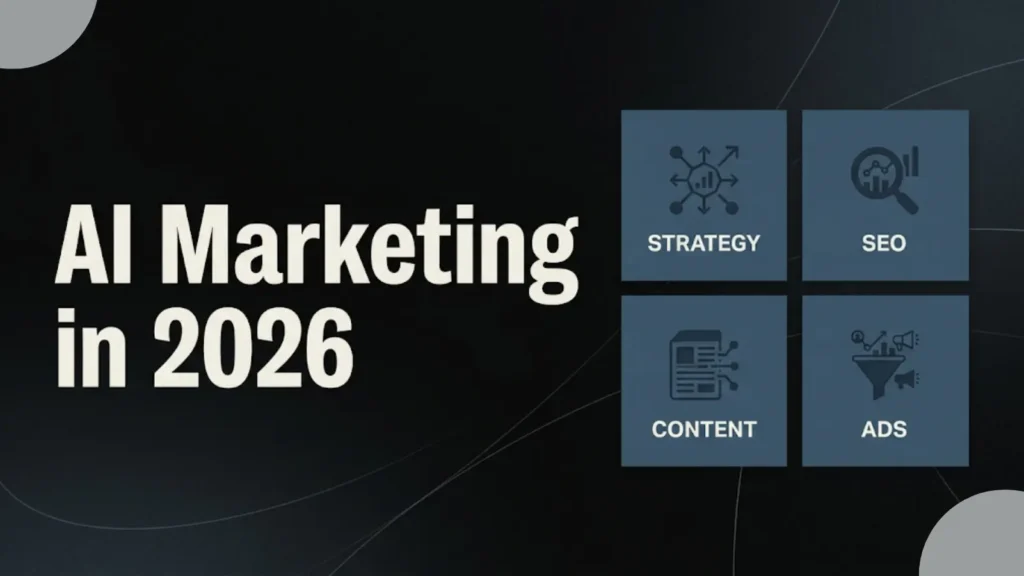
AI marketing is no longer just about using ChatGPT for captions or blog ideas. In 2026, it has become a real business system.
Companies now use AI to speed up research, improve ad performance, produce content faster, analyze customer behavior, and automate parts of execution. But most businesses still misunderstand it. They either expect AI to replace strategy or use it randomly with no system behind it.
This guide explains what AI marketing actually means, where it works, where it fails, and how businesses should use it in 2026 without wasting time, budget, or trust.
What AI Marketing Actually Means
AI marketing means using artificial intelligence tools and systems to improve marketing decisions, production, personalization, and performance.
In practical terms, AI marketing is not one tool or one software. It is also not just content generation.
It includes using AI for:
- keyword and topic research
- content briefs and outlines
- ad copy testing
- audience segmentation
- email personalization
- analytics interpretation
- workflow automation
- predictive recommendations
- chatbot support
- creative variation generation
The real value of AI marketing is simple: it helps teams move faster, spot patterns sooner, and reduce manual work in repetitive tasks.
But AI is not the same as strategy.
AI can help you write. It cannot decide what your business should stand for.
AI can suggest targeting. It cannot fully understand your market context the way a strong operator can.
AI can generate options. It should not make every decision.
That is the core distinction businesses need to understand in 2026.
Read More:- AI Marketing vs Traditional Digital Marketing: What Actually Changes?
How AI Marketing Is Used in SEO, Content, and Ads
AI marketing becomes useful when you look at it by channel, not as a vague trend.
AI in SEO
In SEO, AI helps teams reduce research and production time.
Common use cases include:
- clustering keywords by intent
- generating content briefs
- identifying topical gaps
- suggesting internal linking opportunities
- rewriting metadata variations
- extracting entity-level content ideas
- summarizing SERP patterns
- scaling content refresh workflows
Where it helps most is research support, pattern recognition, and workflow speed.
Where it falls short is authority, backlinks, and original insight. AI can produce search-shaped content, but not always rank-worthy content.
If your SEO strategy is just “publish more AI content,” it is weak. A better approach is to use AI to support content systems while humans control quality, differentiation, and intent alignment.
AI in Content Marketing
AI has changed content production more than most channels.
Businesses use AI for:
- topic ideation
- article outlines
- first drafts
- repurposing blog content into social posts
- headline generation
- email drafts
- video script generation
- newsletter summaries
- content personalization by audience segment
The biggest gain is speed.
A team that once published four solid articles a month can now move much faster on research, structure, and first drafts. But speed without editorial judgment creates low-value content.
The winning model is not “AI writes everything.” It is “AI accelerates production, humans sharpen the thinking.”
In 2026, content quality is not about who types faster. It is about who combines AI efficiency with real insight, original framing, and clear positioning.
AI in Performance Marketing and Ads
This is where AI marketing connects directly to money.
AI is now heavily used for:
- ad copy variation generation
- image and creative ideation
- audience analysis
- landing page personalization
- bid optimization support
- performance anomaly detection
- campaign reporting summaries
- predictive lead scoring
- customer journey analysis
For paid ads, AI works best when it helps marketers test faster and interpret data faster.
For example, a business running Meta Ads or Google Ads can use AI to generate 20 copy angles, summarize winning messaging patterns, and identify landing page drop-off points. That improves the speed of iteration.
But AI still cannot fix a bad offer, weak hooks, poor targeting, or broken unit economics.
If your CAC is high because your offer is weak, AI will not save it.
If your landing page does not convert, AI-generated ad copy alone will not fix it.
AI improves execution. It does not erase business problems.
Benefits of AI Marketing
Used properly, AI marketing gives businesses real advantages.
1. Faster execution
Teams can move faster across research, content, reporting, and creative testing. That matters when competitors are slow.
2. Lower manual workload
AI cuts time spent on repetitive work like summarizing reports, drafting variations, sorting ideas, and organizing data.
3. Better testing volume
Marketers can generate more ad variants, headline options, email subject lines, and content angles in less time.
4. Faster data interpretation
AI tools can summarize campaign reports, flag anomalies, and surface patterns teams may miss manually.
5. Improved personalization
AI can support segmentation, dynamic messaging, and user-specific recommendations at a level that is hard to execute manually at scale.
6. Better leverage for small teams
A lean marketing team can operate with more capacity when AI supports the workflow correctly.
These benefits only show up when there is a system behind the tool.
Random AI usage creates random output.
Where AI Marketing Fails
This is the part many businesses skip.
AI marketing is useful, but it breaks fast when used in the wrong places.
AI fails without strategy
If you do not understand your audience, offer, positioning, or funnel, AI will only help you produce confusion faster.
It can create content and ads, but it cannot build a go-to-market foundation by itself.
AI fails when businesses chase volume over quality
Publishing 100 AI-generated blog posts does not mean you built authority. Creating 50 ad variations does not mean you improved conversions.
AI makes it easier to flood channels with average work. That is a risk, not an advantage.
AI fails at originality
AI is trained on patterns. That makes it useful for structure and variation, but weak at original thought.
If your brand needs distinct positioning, strong opinions, novel frameworks, or deep category insight, human thinking still matters.
AI fails when outputs are not reviewed
This is where businesses get exposed.
Common problems include:
- factual errors
- generic claims
- weak examples
- repetitive wording
- off-brand tone
- outdated recommendations
- shallow content that sounds polished but says little
AI output can look finished while still being wrong.
AI fails when businesses expect replacement, not support
Replacing writers, marketers, or strategists with AI usually creates fragile systems.
The smarter model is augmentation: use AI to improve operators, not remove thinking.
Read More:- Best AI Marketing Tools for Content, SEO, and Ads
Best AI Marketing Use Cases for Businesses
Not every use case creates equal value. Some produce real ROI. Others are mostly noise.
Here are the strongest use cases for businesses in 2026.
1. Content research and production support
Use AI to:
- build topic maps
- generate outlines
- create draft sections
- repurpose long-form content
- extract FAQs
- identify missing subtopics
This works well for blogs, landing pages, newsletters, and social content.
2. Ad creative and copy iteration
Use AI to:
- generate multiple hooks
- rewrite offers by audience type
- test CTA angles
- create new messaging styles
- summarize top-performing creatives
This matters because paid media performance improves through testing speed.
3. Reporting and analytics summaries
AI can turn messy campaign data into readable summaries. That helps founders and teams understand what is working without digging through dashboards for hours.
4. Customer support and pre-sales automation
AI chatbots and assistants can answer common questions, qualify users, and reduce friction during the buying journey.
This works best when the business has clear FAQs, service logic, and solid documentation.
5. Email personalization and lifecycle support
AI helps businesses create segmented email content, test subject lines, and tailor messaging across welcome, nurture, and re-engagement flows.
6. SEO workflow systems
AI is especially useful behind the scenes in SEO operations:
- keyword clustering
- brief creation
- refresh suggestions
- content optimization support
- topical map expansion
AI Marketing Tools to Know
You do not need 25 tools. You need a focused stack.
Here are the main categories businesses should know.
AI assistants
Used for research, drafting, ideation, summaries, and workflow support.
Examples:
- ChatGPT
- Claude
- Gemini
AI writing and content workflow tools
Used for briefs, optimization, rewriting, and content production support.
Examples:
- Jasper
- Copy.ai
- Writer
AI SEO tools
Used for keyword clustering, content optimization, SERP analysis, and topical workflows.
Examples:
- Surfer
- Clearscope
- Frase
- MarketMuse
AI design and creative tools
Used for visual asset generation, ad creative ideation, and brand asset production.
Examples:
- Canva AI features
- Midjourney
- Adobe Firefly
AI automation tools
Used to connect systems and trigger actions across tools.
Examples:
- Zapier with AI workflows
- Make
- Notion AI workflows
The goal is not to choose the most popular tools. The goal is to choose tools that fit your actual workflow.
Read More:- What Is AI Marketing and How Does It Actually Work?
How to Start With AI Marketing
Most businesses get stuck because they try to “adopt AI” as a broad idea instead of solving one practical problem at a time.
Here is the better approach.
Step 1: Identify one bottleneck
Pick one area where work is slow, repetitive, or inconsistent.
Examples:
- blog research takes too long
- ad testing is too limited
- reports are too messy
- email content is too slow to produce
Start there.
Step 2: Add AI to the workflow, not the whole department
Do not try to rebuild your entire marketing system at once.
Instead:
- keep the human workflow
- insert AI into one stage
- measure whether it improves speed or output quality
Step 3: Build prompts, SOPs, and review rules
AI becomes more useful when your team defines:
- what inputs go in
- what output format is expected
- what quality checks happen before publishing
- what must always be reviewed by a human
Without process, AI output stays inconsistent.
Step 4: Measure results
Track real impact.
Look at:
- time saved
- output volume
- conversion rate impact
- content engagement
- CPL or CAC changes
- workflow efficiency
If AI does not improve one of these, it may just be adding noise.
Step 5: Expand only after one win
Once one workflow works, move to the next.
That keeps adoption practical and avoids tool overload.
Common Mistakes to Avoid
Businesses keep making the same mistakes.
Using AI with no clear goal
If the goal is vague, the output will be vague too.
Letting AI publish unedited work
This damages trust, quality, and brand perception.
Chasing tools instead of systems
A shiny tool does not create a strong marketing process.
Confusing more content with better marketing
Volume helps only when quality, intent, and differentiation are strong.
Ignoring brand voice
AI-generated content often sounds flat unless guided properly.
Treating AI as a shortcut to strategy
This is one of the biggest mistakes in AI marketing today.
Strategy still comes first. AI should support the plan, not replace it.
Actionable Takeaways
If you are serious about AI marketing in 2026:
- use AI to remove repetitive work, not strategic thinking
- start with one clear use case instead of trying to automate everything
- apply AI across SEO, content, and ads where speed matters
- keep human review for quality, accuracy, and positioning
- build repeatable workflows instead of depending on random prompts
- measure business impact, not just output volume
The businesses winning with AI marketing are not the ones using the most tools.
They are the ones using AI with discipline.
Conclusion
AI marketing in 2026 is useful, but only when understood correctly. It is not magic, and it is not a replacement for real marketing fundamentals.
It helps businesses move faster, test more, and reduce manual effort across SEO, content, ads, email, and analytics. But it also fails when strategy is weak, review is missing, or businesses mistake speed for effectiveness.
The right way to use AI marketing is simple: let AI support execution, let humans control judgment, and build systems that improve business outcomes.
If you want to build a real AI marketing system, do not stop at the overview level. Read the supporting guides on AI content workflows, AI ad testing, and AI-powered marketing systems to turn this into execution.
FAQs
What is AI marketing?
AI marketing is the use of artificial intelligence tools and systems to improve marketing tasks like research, content creation, ad testing, personalization, analytics, and automation.
Is AI marketing good for small businesses?
Yes. AI marketing can help small businesses save time, increase output, and improve efficiency, especially in content, email, customer support, and ad creative testing. But it still needs human oversight.
Can AI replace marketers?
No. AI can improve speed and reduce manual work, but it cannot fully replace strategy, positioning, judgment, and original thinking.
What are the best AI marketing use cases in 2026?
The strongest use cases include content research, ad copy testing, reporting summaries, email personalization, SEO workflow support, and chatbot-based customer interactions.
What is the biggest mistake in AI marketing?
The biggest mistake is using AI without strategy. Many businesses produce more content or more ad assets without improving the offer, positioning, or customer journey.