
SEO for Architects
Strategic SEO support for architects and architecture firms that want stronger discoverability without cluttering a visually strong website with low-trust SEO.
Built for interior designers who want stronger discoverability without clutter-heavy SEO.
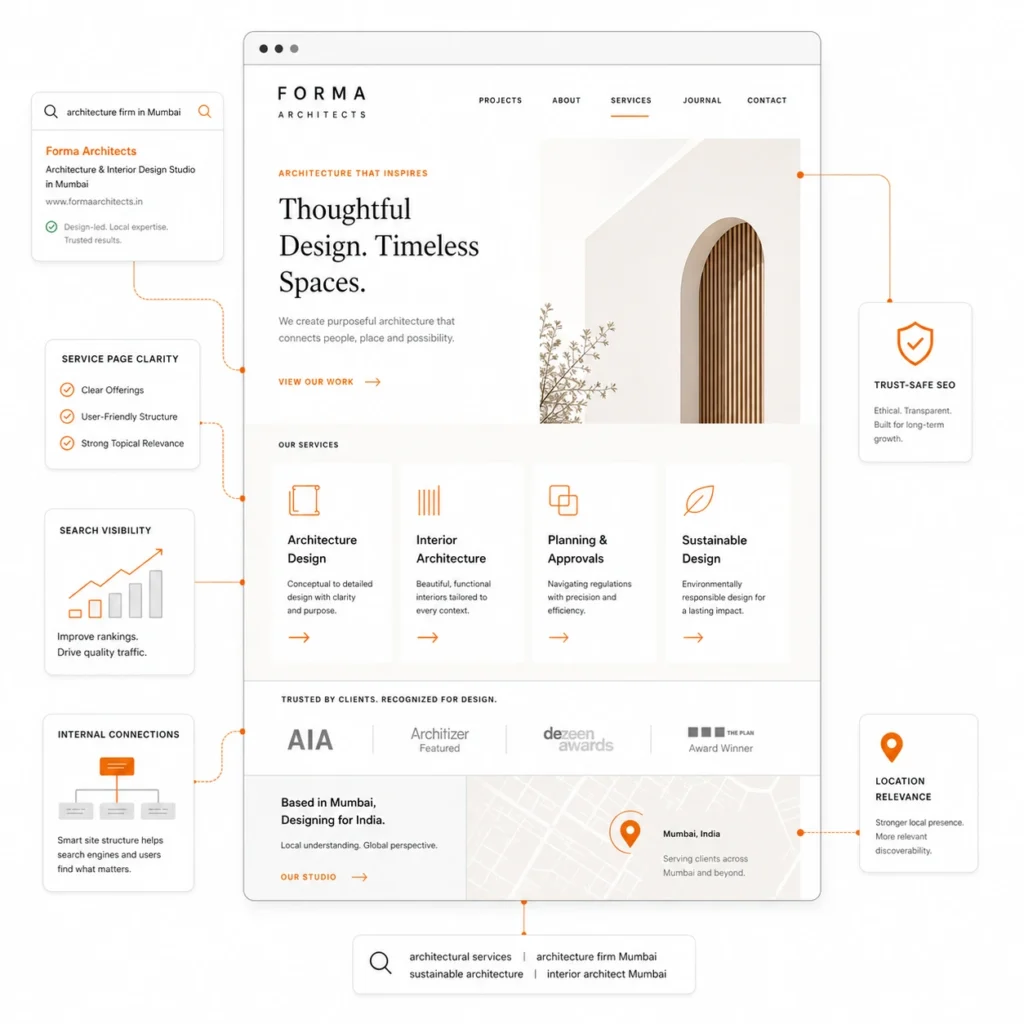
Why Many Architecture Websites Still Underperform in Search
`Many architecture websites already look polished, credible, and visually strong.
The project work looks impressive.
The brand presentation feels professional.
The website often creates the right visual impression.
But when it comes to search visibility, discoverability, and service-led performance, the website still underperforms.
The problem is usually not design quality.
The problem is that important pages are often not structured around:
clear service intent
location relevance
discoverability pathways
search-led messaging
stronger internal visibility support
An architecture website can look premium and still remain weak as a search asset.
That is the gap this work is built to address.`
A website can look premium and still remain weak as a search asset.
That is the gap this work is built to address.
That usually means the website is missing things like:
Service intent
Important pages often showcase projects well but do not clearly frame what the firm actually offers.
Location relevance
Search visibility weakens when architecture services and locations are not clearly connected.
Discoverability pathways
A strong portfolio alone does not create the internal pathways needed to support search visibility.
Search-led messaging
The presentation may feel premium, but the copy often does not support how potential clients actually search.
Strong design creates trust. Strong visibility still needs structure.
Built for Architects Who Care About Visibility and Brand Quality
This page is designed for architects and design-led firms who want stronger search discoverability without compromising the premium quality and identity of their brand online.
If your portfolio looks premium but still feels invisible in search, this work is built for that exact kind of problem.
It is especially relevant for businesses that:
- already have a visually strong website
- care deeply about trust, aesthetics, and brand presentation
- want stronger search visibility without clutter-heavy SEO
- need clearer service-page direction
- want practical, strategic support instead of generic agency activity
This page is built for:
- Architects
- Architecture firms
- Residential architects
- Commercial architecture studios
- Design-led firms
What SEO for Architects Should Actually Focus On
`SEO for architects should not start with generic content expansion, random keyword insertion, or clutter-heavy page building.
It should start with the parts of the website that matter most for discoverability and trust.
The goal is not to overload the website with more SEO elements than it can carry well.
The goal is to make the website easier to discover without weakening how the brand is presented.`
That is a very different approach from generic SEO execution.
Service-page clarity
Important pages should clearly explain what the firm does, not just look visually impressive.
Project and service alignment
The site should connect project work to actual services in a way search systems can understand.
Location relevance
If geography matters, services and locations need stronger alignment.
Search-led messaging
The copy should match how potential clients actually search for architecture services.
Internal page relationships
Homepage, services, portfolio, and supporting content should reinforce each other.
Trust-preserving structure
Discoverability should improve without making the site feel cluttered, noisy, or cheap.
Common Visibility Problems This Work is Designed to Help Improve
This work is designed to help solve problems such as:
In many cases, they come from unclear page intent, weak structure, low message alignment, and the absence of a stronger visibility system.
That is where the work begins.`
A visually strong architecture website that still ranks weakly
The website looks premium, but search performance does not reflect that quality.
Service pages that do not clearly match what potential clients search
Important services are not framed in a way that supports search intent and discoverability.
Weak location and service visibility
Service and location relevance are not clearly connected, which weakens local search support.
Portfolio-heavy structure with weak discoverability
The portfolio may be strong, but the site often lacks the pathways that help key pages perform.
Content that does not support search intent
The website has content, but it does not clearly align with how potential clients search.
Generic SEO tactics that risk making the website feel cheaper than the brand deserves
Generic SEO changes can damage trust, presentation, and premium brand perception.
Why Generic SEO Often Fails for Architecture Websites
`Architecture websites cannot be treated like generic template service sites.
When the website already depends on credibility, design quality, and perception, clutter-heavy SEO can do more harm than good.`
Good SEO for interior designers should improve visibility without making the website feel over-optimized, noisy, or cheap.
What generic SEO often pushes
- more pages
- more keywords
- more content clutter
- more low-trust elements
- more activity before real clarity
What works better here
- cleaner structure
- clearer service intent
- stronger location and service framing
- messaging aligned with how clients actually search
- discoverability systems that support trust
The Best Starting Point is Usually Clarity
For many architecture websites, the best starting point is the 14-Day SEO Visibility Sprint.
Before scaling city pages, service pages, content, or broader SEO work, the website usually needs clearer visibility direction first.`
14-Day SEO Visibility Sprint
A focused starting point for interior design websites that need stronger visibility direction before more SEO activity is added.
identify discoverability blockers
clarify page-level issues
strengthen service visibility
create better next-step direction
A better first step before scaling city pages, service pages, content, or broader SEO work.

Mayank Singh Rajput
Digital Marketing Expert
SEO
Visibility Strategy
Content Systems
Practical thinking for discoverability, clarity, and trust-led growth.
Led by Mayank Singh Rajput
This work is led by Mayank Singh Rajput, founder of MayankUnfiltered and a digital marketing expert focused on practical SEO, visibility strategy, and content systems for premium service businesses.
The work is guided by a simple belief:
That belief matters even more for interior design websites, where brand presentation is already a major part of trust.
Instead of defaulting to generic SEO activity, the focus stays on what is weak, what is unclear, and what needs to change first.
If Your Architecture Website Looks Strong But Still Struggles in Search, Start with Clarity
A strong portfolio and professional presentation do not automatically create discoverability.
If the website still feels weak as a search asset, the best next step is to start with clearer visibility direction before adding more SEO activity.
That is what the 14-Day SEO Visibility Sprint is built to help create.
Start with clarity. Then improve what matters most.`
A practical next step for interior design websites that need stronger discoverability without clutter-heavy SEO.