Most businesses hear the word “personalization” and immediately think of expensive software, giant automation stacks, and enterprise-level complexity.
That is the wrong way to look at it.
For a small team, personalization is not about building a huge machine. It is about understanding how people move from first touch to decision, spotting intent faster, and improving the message at the right moment.
That is where AI customer journey mapping becomes useful.
In 2026, more marketers are moving beyond basic AI use and toward AI-assisted decision-making across workflow, segmentation, and communication. At the same time, trust, clarity, and relevance still matter more than automation alone.
AI does not magically create a better customer journey.
It helps you read patterns faster.
It helps you segment behavior better.
It helps you notice drop-off points earlier.
It helps you improve follow-up timing without manually tracking everything.
But it also creates a new risk.
If your offer is weak, your messaging is vague, or your data is messy, AI does not fix that. It scales it.
If you are new to the broader idea of AI in business growth, this article works best alongside your existing AI marketing guide and AI marketing workflow pieces.
What AI Customer Journey Mapping Actually Means
A customer journey map is the path a person takes before becoming a customer.
Usually, that path looks something like this:
- discovery
- interest
- consideration
- decision
- post-conversion experience
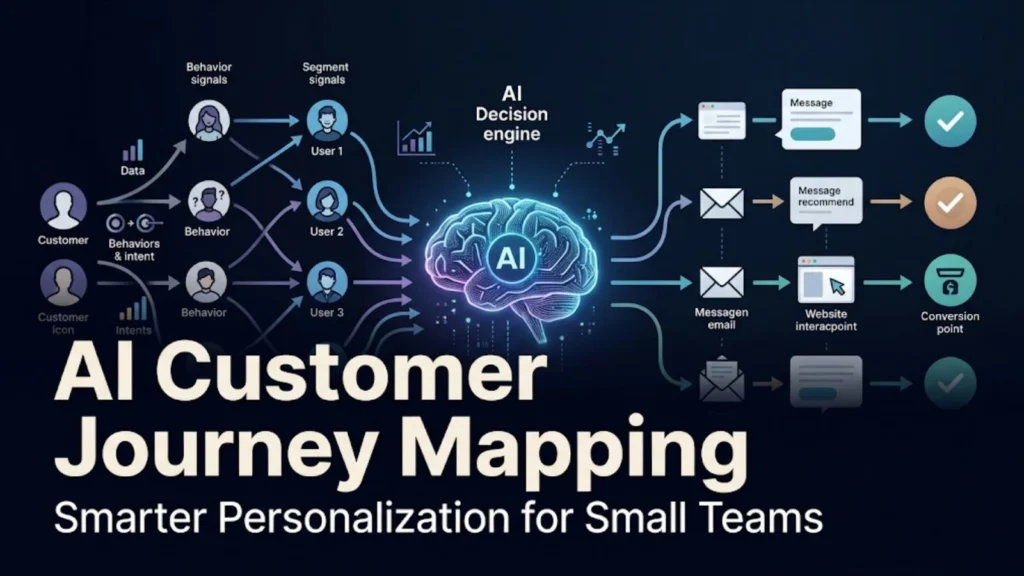
AI customer journey mapping means using AI to understand that path better, organize audience signals faster, and improve messaging across each stage.
Not in a hype-heavy way.
In a practical way.
For a small team, this can mean using AI to:
- detect patterns in on-site behavior
- group visitors by likely intent
- identify drop-off points
- improve follow-up timing
- personalize messaging based on stage, not guesswork
The real goal is not to make the journey more complicated.
The goal is to make it easier to understand and easier to improve.
Why Small Teams Should Care in 2026
Small teams usually do not lose because they lack enterprise tools.
They lose because they lack visibility, consistency, and clarity.
That is why this topic matters.
Right now, the market is shifting toward more intelligent AI use, but the teams that win are still the ones that combine automation with clear positioning, useful segmentation, and better decisions.
For a lean business, that creates a practical advantage.
You do not need a giant personalization stack.
You need:
- a clear customer journey
- a few strong behavior signals
- useful intent-based segmentation
- better follow-up logic
- human judgment where it matters
That is enough to outperform businesses that automate too much before they understand what is actually happening inside the buyer journey.
Where AI Helps Inside the Customer Journey
AI becomes valuable when it improves visibility and timing.
Not when it adds noise.
Behavior Analysis
Most small teams already have useful signals.
They just do not organize them properly.
People visit pages.
They return to the site.
They stay longer on some service pages.
They click certain emails.
They ignore some offers and respond to others.
AI can help detect those patterns faster than manual review.
Instead of guessing who looks interested, you start noticing stronger signals like:
- repeated visits to pricing or service pages
- higher engagement from one traffic source
- stronger interaction with a certain topic cluster
- recurring drop-offs at the same stage
That makes the journey easier to read.
Segmentation
Segmentation is where personalization starts becoming real.
Without segmentation, most personalization is just template editing.
AI can help group users by:
- awareness level
- likely pain point
- buying intent
- content interest
- stage of decision-making
- returning vs first-time behavior
That matters because a first-time reader should not get the same message as someone who has already explored your service page three times.
If someone is still in the research stage, pushing a hard conversion message too early usually weakens the experience.
Intent Detection
A customer journey is not just a set of pageviews.
It is a sequence of decisions.
AI can help identify whether a person looks more like:
- a learner
- a comparer
- a high-intent lead
- a low-fit lead
- an information-only visitor
That changes how you communicate.
You stop forcing a sales CTA on people who still need clarity.
You stop sending educational content to someone who is already close to a decision.
Follow-Up Timing
Timing matters more than most businesses think.
A decent message at the right time often performs better than a stronger message sent too late.
AI can help with:
- identifying engagement windows
- spotting inactivity patterns
- prioritizing follow-up timing
- suggesting when a reminder makes sense
- reducing random manual follow-ups
This is especially useful for small teams that do not have time to watch every movement manually.
Message Personalization
This is the part people overhype the most.
AI can help personalize messaging, but only if the business already understands the customer journey clearly.
Useful personalization is not just inserting a name or changing one sentence.
Useful personalization means:
- matching the message to the stage
- matching the CTA to the level of readiness
- matching the example to the use case
- matching the proof to the likely objection
That is where AI becomes helpful.
Not in surface-level customization.
In contextual relevance.
Where AI Personalization Goes Wrong
This is where many teams make bad decisions.
They assume AI automatically makes the journey smarter.
It does not.
Fake Personalization
A lot of businesses call something personalized when it is just slightly edited automation.
That is not enough.
If the message still ignores the buyer’s real stage, real concern, or real level of readiness, then it is not meaningful personalization. It is just automated noise.
Wrong Assumptions
AI depends on the signals and logic behind the system.
If your business wrongly assumes that every pricing-page visit means strong intent, or every email open means buying interest, then your journey map becomes distorted.
That leads to weak segmentation and poor follow-up.
Bad Data
Messy CRM data.
Unclear tagging.
Broken attribution.
Duplicate contacts.
Confused lead stages.
This is where AI starts doing damage faster.
It turns weak inputs into faster confusion.
Over-Automation
Some teams automate too early.
They set up sequences, triggers, and personalized journeys before they understand what actually moves the customer forward.
That creates complexity without clarity.
And complexity is not maturity.
A small team usually does not need more automation first.
It needs fewer, better decisions.
A Simple AI Customer Journey Mapping Framework for Small Teams
Do not start with tools.
Start with the journey.
Step 1: Define the Core Journey
Map the simplest version of the path:
- first touch
- interest
- consideration
- decision
- post-conversion
Do not create 15 unnecessary stages.
Keep it usable.
Step 2: Identify the Strongest Signals
Choose the signals that actually matter.
Examples:
- visited pricing or service page
- returned within 7 days
- clicked a comparison-focused email
- viewed a case study
- downloaded a resource
- replied to outreach
You do not need more signals.
You need better ones.
Step 3: Group by Intent, Not Just Demographics
Intent is more useful than generic audience labels.
Build simple buckets such as:
- cold researcher
- interested explorer
- active comparer
- high-intent lead
- low-fit lead
This makes follow-up more relevant.
Step 4: Match Message to Stage
For each segment, ask:
- what do they need to understand now?
- what friction is blocking action?
- what proof would help?
- what CTA fits this stage?
This is where personalization starts becoming useful.
Step 5: Use AI for Speed, Not for Thinking
Use AI to:
- summarize lead behavior
- cluster journey patterns
- identify likely friction points
- suggest message drafts
- prioritize follow-up
Do not use AI to replace judgment.
Use it to reduce manual friction.
Customer Journey Stage vs AI Help vs Risk vs Human Input
| Customer Journey Stage | AI Help | Risk | Human Input |
|---|---|---|---|
| Awareness | Detect content engagement and source patterns | Misreading curiosity as real intent | Decide which signals actually matter |
| Interest | Group visitors by behavior and topic interest | Over-segmentation with weak data | Define useful audience buckets |
| Consideration | Identify likely objections and comparison behavior | Wrong readiness assumptions | Improve proof, examples, and offer clarity |
| Decision | Prioritize timing and stage-based follow-up | Premature or overly aggressive automation | Review high-intent leads manually |
| Post-Conversion | Spot retention or upsell patterns | Spammy lifecycle messaging | Keep relationship context human-led |
AI personalization works best when it improves relevance, not when it pretends to understand people better than your business actually does.
Tools Are Not the Main Advantage. Clarity Is.
This is the part many businesses ignore.
The advantage is not the software.
The advantage is the thinking behind it.
A business with:
- clear positioning
- a strong offer
- simple journey stages
- usable customer signals
- relevant follow-up logic
will usually outperform a messy business using better tools.
That is why some small teams get real value from lightweight AI workflows while others waste money on systems they barely understand.
The tool becomes useful after the journey becomes clear.
Without clarity, personalization becomes expensive confusion.
If you want the broader ecosystem view, this topic also connects naturally with agentic AI in marketing and your article on the best AI marketing tools.
Mayank’s Take
Most businesses do not have a personalization problem.
They have a clarity problem.
They do not clearly understand:
- who they want
- what stage that person is in
- what objection is blocking action
- what message should come next
So when they add AI, they expect intelligence.
But AI only scales what already exists.
If your customer journey is unclear, AI scales confusion.
If your signals are weak, AI scales bad decisions.
If your offer is strong, your journey is simple, and your messaging matches real buyer intent, AI becomes genuinely useful.
That is the real advantage.
Final Thoughts
AI customer journey mapping is not about acting bigger than you are.
It is about becoming more precise than you were before.
For small teams, that is enough.
You do not need enterprise complexity.
You need:
- a simple journey
- clearer signals
- tighter segmentation
- better timing
- more relevant messaging
That is where AI starts helping.
Not as a magic system.
As a force multiplier for clarity.
FAQs
What is AI customer journey mapping?
AI customer journey mapping is the process of using AI to understand how people move from discovery to decision, identify behavior patterns, segment intent, and improve messaging across that journey.
Is AI customer journey mapping only for big companies?
No. Small teams can use it in simpler ways by tracking a few strong signals, segmenting users by intent, and improving follow-up timing and messaging without needing enterprise-level tools.
How does AI help with personalization?
AI helps by identifying behavior patterns, grouping people by likely stage or intent, suggesting relevant messaging, and improving follow-up timing. It works best when the business already has clear offers and usable customer data.
What are the biggest mistakes in AI personalization?
The biggest mistakes are fake personalization, weak data, wrong assumptions about intent, and over-automation before the business understands what actually drives conversions.
Do I need expensive tools for AI customer journey mapping?
No. Most small teams need clarity, usable signals, and simple workflow logic more than expensive software. Tools help after the journey is already clear.
What is the difference between automation and personalization?
Automation is about triggering actions faster. Personalization is about making those actions more relevant. A business can automate many things and still fail to personalize well.