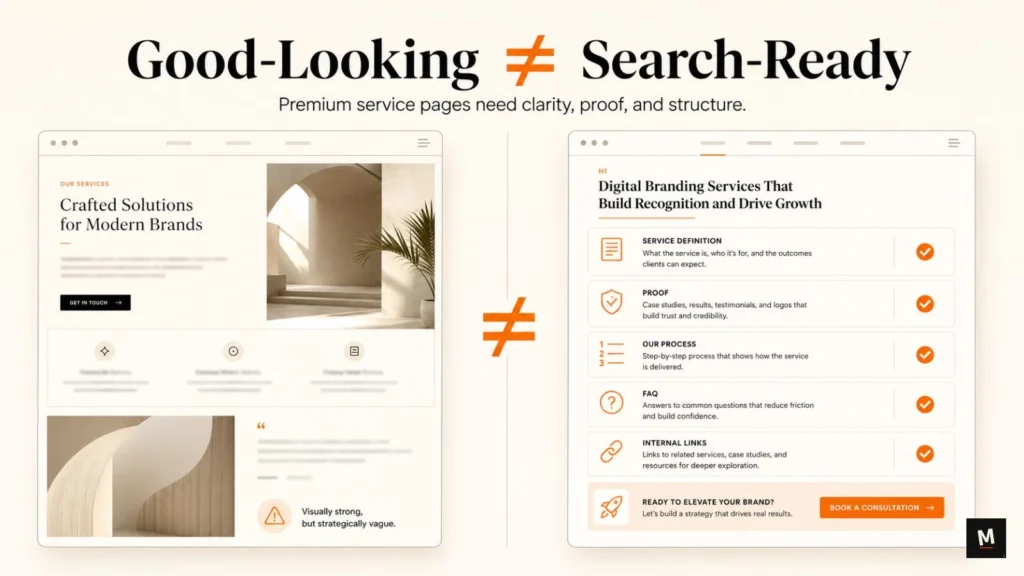
A website can look premium and still fail at SEO.
This happens more often than most service businesses want to admit.
The homepage looks clean.
The fonts look elegant.
The images look expensive.
The copy sounds polished.
But the service page still does not rank.
And even when people visit the page, they do not clearly understand what the business offers, who it is for, why it is credible, or what they should do next.
That is the problem.
A good-looking website can create a strong first impression. But search visibility needs more than design. It needs clarity, structure, relevance, proof, and intent alignment.
Google’s own guidance says its ranking systems are designed to prioritize helpful, reliable content created to benefit people, not content made mainly to manipulate search rankings. (Google for Developers)
That matters because a premium service page cannot just look beautiful.
It has to be useful.
It has to explain the service clearly.
It has to help both Google and serious buyers understand why the page deserves attention.
Expert Note: Premium design can create attention. Clear service-page strategy creates search understanding.
If your website already looks strong but still lacks visibility, this is one of the common issues checked inside the SEO Visibility Sprint.
A Premium Website Can Still Be Weak for SEO
Design and SEO solve different problems.
Design helps with perception.
SEO helps with discovery, understanding, and relevance.
A premium design can make your business look established. But if the page does not explain the service properly, Google may still struggle to understand what the page should rank for.
A common example:
“We create timeless spaces for modern lifestyles.”
This sounds premium.
But what does it actually tell Google?
Not much.
It does not clearly explain:
- what service is offered
- who the service is for
- which location is being served
- what type of project is handled
- what proof supports the claim
- what the visitor should do next
A buyer may also feel the same confusion.
They may like the design, but still wonder:
“Is this service right for me?”
That gap hurts SEO and conversions.
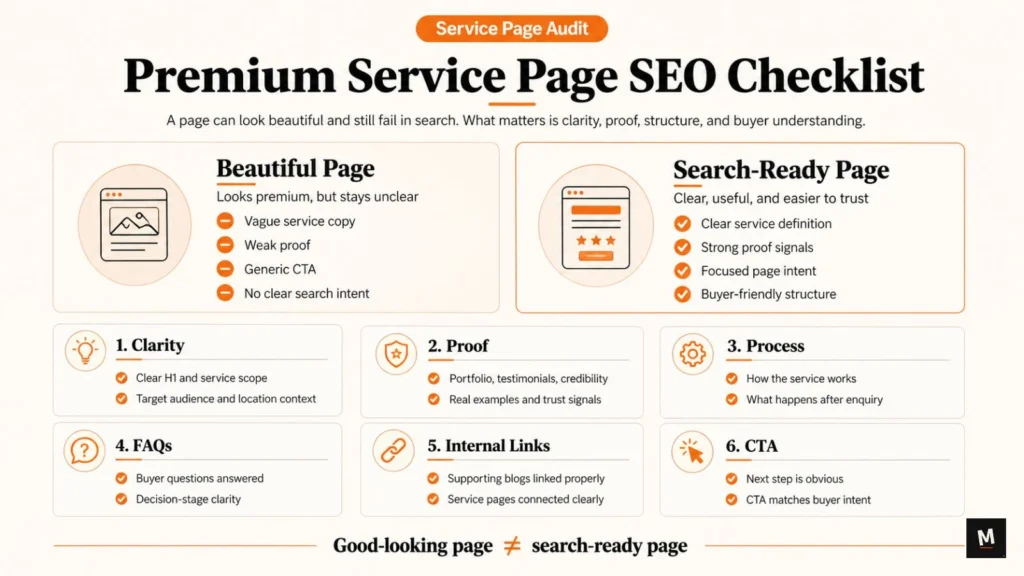
Callout: Good-looking page ≠ search-ready page.
The Real Problem Is Not Design. It Is Service-Page Clarity
Most premium service pages do not fail because they look bad.
They fail because they are unclear.
The page may use polished language, but it does not answer basic buyer and search questions.
A strong service page should make these things clear:
- What exactly do you offer?
- Who is this service for?
- Which location or market do you serve?
- What problem do you solve?
- What is included in the service?
- What proof do you have?
- What happens after someone contacts you?
- Why should someone trust you over another provider?
This is where many premium businesses lose visibility.
They invest in branding, photography, animation, and design.
But the actual service explanation remains thin.
Google’s helpful content guidance encourages site owners to evaluate whether content is genuinely useful and whether visitors would feel they had a satisfying experience after reading it. (Google for Developers)
That is exactly where service-page clarity matters.
| Premium-Looking Page | SEO-Ready Service Page |
|---|---|
| Focuses on brand language | Focuses on buyer understanding |
| Uses broad claims | Explains specific service value |
| Looks polished | Matches search intent |
| Has weak proof | Shows trust signals |
| Has generic CTA | Guides the next step clearly |
For premium businesses, this is not just a content issue. It is a business visibility issue.
That is why SEO consulting for premium service businesses should not start with random keywords. It should start with page clarity.
Why Google May Struggle to Understand a Premium Service Page
Google does not rank a page just because it looks expensive.
Google needs to understand the page.
A service page becomes harder to understand when it has:
- a vague H1
- generic H2s
- weak service definition
- no clear target audience
- no location or market context
- no process explanation
- no proof section
- no FAQs
- no supporting internal links
- no topical depth around the service
This does not mean you should stuff keywords everywhere.
That is lazy SEO.
The real goal is to make the page understandable.
A page about luxury interior design should clearly explain the type of interior design service, the project types, the location, the client profile, the process, the proof, and the next step.
A page about architecture services should explain the project category, design approach, location relevance, approval or planning context, portfolio proof, and consultation path.
Search is also becoming more context-heavy.
Google says AI Overviews and AI Mode may use a query fan-out technique, issuing multiple related searches across subtopics and data sources to develop a response. (Google for Developers) Google has also explained that AI Mode can break a question into subtopics and issue multiple queries at once. (blog.google)
This means shallow service pages are easier to ignore.
If your page does not explain the service deeply, it gives search systems less useful information to work with.
Common Mistake: Many businesses add the target keyword to the title and assume the page is optimized. But if the page does not explain the service properly, the keyword alone will not fix weak understanding.
7 Reasons Premium Service Pages Don’t Rank
1. The Page Talks Like a Brand Brochure, Not a Search Result
Premium businesses often use abstract copy.
Examples:
- “Bespoke solutions”
- “Transformative experiences”
- “End-to-end excellence”
- “Designed for modern living”
- “Crafted with passion”
- “Built for modern brands”
These lines may sound polished, but they do not answer search intent.
A buyer searching for a service is usually trying to understand something specific.
They want to know:
- Can you solve my problem?
- Do you serve my location?
- Have you handled similar work?
- What exactly is included?
- What should I expect?
- Why should I trust you?
A service page cannot survive only on mood-based copy.
It needs clear service language.
Weak copy:
We design elevated environments for modern lifestyles.
Clear copy:
We provide full-home interior design services for premium apartments, villas, and luxury residences in Bangalore.
The second version is not less premium.
It is just more useful.
That is the balance premium service businesses need.
If you are building visibility for an interior design business, this is especially important. A page targeting SEO for interior designers needs to connect design quality with search clarity.
Reader Action: Take one abstract sentence from your service page and rewrite it into one clear service sentence.
Ask:
- What service is this?
- Who is it for?
- Where is it relevant?
- What outcome does it support?
2. The Page Does Not Match One Clear Search Intent
One service page cannot rank for everything.
This is one of the biggest mistakes on premium business websites.
A single page tries to target:
- luxury interior design
- modular kitchen design
- villa interiors
- office interiors
- interior designer in Dubai
- turnkey interiors
- home renovation
- commercial design
That creates confusion.
Google needs to understand the main purpose of the page.
A buyer also needs to understand the main purpose of the page.
If one page tries to carry too many different services, it becomes weak for all of them.
| Page Mistake | Better SEO Direction |
|---|---|
| One page targets too many services | Create focused service or location pages |
| Homepage targets every keyword | Use homepage for brand positioning and routing |
| Service page targets blog intent | Create supporting blog content |
| Blog targets commercial service query | Link it to the right money page |
This is also why a page can be indexed but still not rank.
Indexing only means Google knows the page exists. It does not mean Google sees the page as strong enough for a competitive query.
If this is your issue, read this related guide on why a website is indexed but not ranking.
3. The Service Is Not Explained Deeply Enough
A service page should not only mention the service.
It should explain the service.
There is a difference.
A thin service page says:
We offer premium interior design services.
A stronger service page explains:
- what type of interiors you design
- who the service is best for
- what project sizes you handle
- what the process looks like
- how consultation works
- what proof you can show
- what decisions the buyer needs to make
- what questions buyers usually ask before contacting you
This is not about making the page long for no reason.
It is about making the page complete enough to be useful.
A premium buyer does not want vague claims.
They want confidence.
They want to know whether you understand their requirement.
They want to know whether you have handled similar work.
They want to know what will happen after they contact you.
That is why a service page should act as a source of truth.
It should help buyers, Google, and AI search systems understand your offer clearly.
This connects with the idea of building a source of truth for AI search, because unclear business information becomes a visibility weakness when search systems need reliable context.
Expert Note: A service page is not just a sales page. It is also a source of truth for search engines, AI systems, and serious buyers.
4. The Page Has Weak Proof Signals
Premium claims need proof.
Most service pages say things like:
- “trusted by clients”
- “years of experience”
- “premium quality”
- “expert team”
- “customer-first approach”
These lines are weak without evidence.
A stronger page shows proof through:
- real project examples
- portfolio context
- before/after details
- client type
- testimonials
- founder expertise
- process explanation
- case studies
- screenshots
- media mentions
- service-specific FAQs
Google’s helpful content guidance includes trust-related self-assessment questions, such as whether the content presents information in a way that makes visitors feel they can trust it. (Google for Developers)
For service pages, trust is not built through adjectives.
It is built through evidence.
Proof Signals a Premium Service Page Should Have
- Real project examples
- Clear process
- Founder or team credibility
- Testimonials or outcomes
- Relevant images
- FAQs based on buyer objections
- Internal links to supporting resources
- Clear explanation of what happens next
A premium service page should not just say, “We are trusted.”
It should show why.
5. The Page Has No Supporting Content Around It
A money page rarely wins alone.
Especially in competitive service categories.
Your main service page needs supporting content around it.
For an interior design business, supporting content can include:
- cost of luxury interior design
- villa interior design process
- interior designer vs contractor
- how to choose an interior designer
- why interior design websites do not rank
- best questions to ask before hiring an interior designer
For an architecture firm, supporting content can include:
- residential architecture process
- architect vs interior designer
- how architecture consultation works
- villa design planning checklist
- how to choose an architect for a home project
This supporting content helps build topical relevance.
It also helps buyers move through the decision journey.
This matters even more as AI search experiences become more layered. Google’s AI features can use query fan-out across related subtopics and sources, so a site with clear supporting content has more chances to be understood around the broader topic. (Google for Developers)
That is why AI search visibility for service businesses is not only about AI tools. It is about making your business easier to understand across search surfaces.
You can also read the related guide on query fan-out SEO for service businesses to understand why supporting content matters.
6. The Page Has Weak Internal Linking
Internal linking is not just about passing link value.
It is about building context.
A strong internal linking system helps Google understand:
- which pages are important
- how topics are connected
- which blogs support which services
- which service pages belong to which niche
- which pages should guide the buyer journey
Many premium websites publish blogs but do not connect those blogs back to the main service pages.
That is a missed opportunity.
For example:
A blog about why architecture websites do not rank should naturally link to SEO for architects.
A blog about interior design search visibility should naturally link to SEO for interior designers.
A blog about weak service pages should naturally link to the SEO Visibility Sprint.
This is not spam.
This is structure.
Reader Action: Open your last five blog posts and check whether they link back to the most relevant service page.
Use natural anchors like:
- SEO Visibility Sprint
- SEO consulting for premium service businesses
- SEO for interior designers
- SEO for architects
- service page visibility review
If your blogs do not support your money pages, your content system is incomplete.
7. The CTA Is Clear Visually, But Weak Strategically
Many premium websites have beautiful CTA buttons.
But the CTA itself is weak.
Example:
Book a Call
There is nothing wrong with this CTA.
But on its own, it may not be enough.
A serious buyer may not be ready to book a call yet.
They may first want to understand:
- what the consultation includes
- whether the service is right for them
- what issue will be reviewed
- what outcome they can expect
- whether the business understands their problem
A better CTA matches the buyer’s stage.
Weak CTA:
Book a call
Better CTA:
Get your service-page visibility reviewed
Another version:
Find out why your premium website is not ranking
For MayankUnfiltered, the CTA should feel diagnostic, not pushy.
Not sure if your service page is clear enough for search?
Start with the SEO Visibility Sprint to identify where visibility is getting blocked — before you publish more content or spend more on SEO.
What a Strong Premium Service Page Should Include
A strong premium service page does not need to be cluttered.
It needs to be clear.
It should include:
- a clear H1
- specific service definition
- target audience
- location or market context
- buyer pain points
- service scope
- process explanation
- proof signals
- FAQs
- comparison or decision guidance
- internal links
- strong CTA
- relevant schema where useful
- real images, not generic decoration
This is the difference between a page that only looks good and a page that can actually support search visibility.
Example: Premium Interior Design Service Page
Let’s take a premium interior design studio.
A weak service page may look like this:
H1:
Luxury Interior Design Services
Copy:
We create premium interiors that reflect your lifestyle.
This sounds fine.
But it is too vague.
A stronger version:
H1:
Luxury Interior Design Services for Villas and Premium Homes in Bangalore
Copy:
We provide full-home interior design services for premium apartments, villas, and luxury residences in Bangalore. Our process covers concept planning, space design, material coordination, execution support, and final styling for homeowners who want a clear, premium, end-to-end design experience.
This version gives more context.
It explains:
- service type
- target client
- project type
- location
- scope
- process
- value
That is better for buyers.
It is also better for search.
| Weak Service Page Copy | Stronger SEO-Ready Copy |
|---|---|
| We create beautiful spaces. | We provide full-home interior design for premium apartments, villas, and luxury residences. |
| Contact us for interiors. | Book a consultation based on your project stage and design requirement. |
| Our team is experienced. | Show portfolio, process, project type, and client proof. |
If your target category is interior design, connect this page properly with your SEO for interior designers page.
Example: Architecture Firm Service Page
Architecture firm websites often have another issue.
They are portfolio-heavy but explanation-light.
The visuals are strong.
The work may be impressive.
But the service page does not explain enough.
A stronger architecture service page should explain:
- residential or commercial specialization
- location or market served
- design process
- project stages
- consultation flow
- approval or collaboration context
- portfolio relevance
- client profile
- FAQs before hiring an architect
A buyer may love the portfolio, but still need answers.
What type of projects do you handle?
Do you work on villas, apartments, commercial buildings, or hospitality spaces?
Do you support design only, or design plus execution coordination?
What happens in the first consultation?
What should the client prepare?
These details matter.
They help buyers make decisions.
They also help search engines understand the service page better.
If architecture is one of your target verticals, the service page should connect naturally with SEO for architects.
How to Audit Your Service Page Before Publishing More Blogs
Many businesses try to fix SEO by publishing more blogs.
That may help.
But not if the core service page is weak.
Before scaling content, audit the money page.
Ask these questions:
- Is the page targeting one clear intent?
- Is the service clearly defined?
- Is the buyer profile clear?
- Is the location or market context clear?
- Is the proof strong enough?
- Are FAQs answering real buyer objections?
- Are supporting blogs internally linking to this page?
- Is the CTA aligned with the buyer’s next step?
- Does the page explain the process?
- Does the page show why the business is credible?
- Would a serious buyer trust this page?
If the answer is no, publishing more blogs may not fix the real issue.
Callout: Do not scale content around a weak service page. Fix the core page first.
This is exactly where the SEO Visibility Sprint fits.
It is not about doing random SEO activity.
It is about finding the visibility blockers that stop important pages from performing.
When This Problem Needs a Deeper SEO Visibility Review
You may need a deeper SEO visibility review if:
- your website looks good but does not rank
- traffic is low despite publishing content
- blogs are ranking but service pages are not
- service pages are indexed but not visible
- AI/search visibility is weak
- important pages have no internal link support
- the website has no clear topical structure
- the CTA gets views but not serious enquiries
This is where the issue is usually deeper than one keyword.
Sometimes the page is not clear enough.
Sometimes the wrong page is targeting the wrong query.
Sometimes the internal links are weak.
Sometimes the supporting content does not exist.
Sometimes the page is indexed but not trusted enough.
If your website is not showing on Google or your website is indexed but not ranking, the answer is not always “publish more content.”
Sometimes the answer is:
Fix the page that should already be ranking.
For premium businesses, this matters even more because the website is not just an information asset.
It is a trust asset.
If your website already looks premium but still lacks search visibility, the issue may not be design.
It may be service-page clarity.
That is where SEO consulting for premium service businesses should focus first.
Final Takeaway
A premium service page should not only look trustworthy.
It should be understandable.
It should be useful.
It should be structured.
It should be proof-backed.
It should help buyers make decisions.
And it should help search engines understand why the page deserves visibility.
Design can make people respect your brand.
Clarity helps search engines and buyers understand why your page deserves attention.
FAQs
Can a beautiful website still have bad SEO?
Yes. A website can look visually strong but still fail SEO if its pages are vague, thin, poorly structured, or not aligned with search intent. Design helps perception, but SEO needs clarity, relevance, and useful content.
Why do service pages fail to rank?
Service pages usually fail to rank because they lack clear service definition, audience context, proof, internal links, FAQs, and search intent alignment. Many pages look polished but do not explain the service deeply enough.
Should I publish more blogs if my service page is not ranking?
Not immediately. First check whether the service page is clear, useful, and properly supported. Publishing more blogs around a weak money page may not fix the actual visibility issue.
What should a premium service page include for SEO?
A premium service page should include a clear H1, service explanation, target audience, location context, process, proof, FAQs, internal links, and a CTA that matches the buyer’s decision stage.
Is service page SEO different from blog SEO?
Yes. Blog SEO usually answers informational questions. Service page SEO must match commercial intent and help buyers understand the offer, proof, process, and next step.