Your website being indexed is not an SEO win.
It only means search engines can access the page.
That does not mean the page is trusted.
That does not mean the page will rank.
That does not mean AI search systems will use it.
And it definitely does not mean the page will bring qualified leads.
This matters because search is changing.
Google is no longer just showing blue links. Users now see AI Overviews and AI Mode, answer-style summaries, service comparisons, product suggestions, and more conversational search experiences.
So the real SEO question is no longer:
“Is my page indexed?”
The better question is:
“Is my page clear, useful, and trustworthy enough to be used as a source?”
That is where AI search visibility starts.
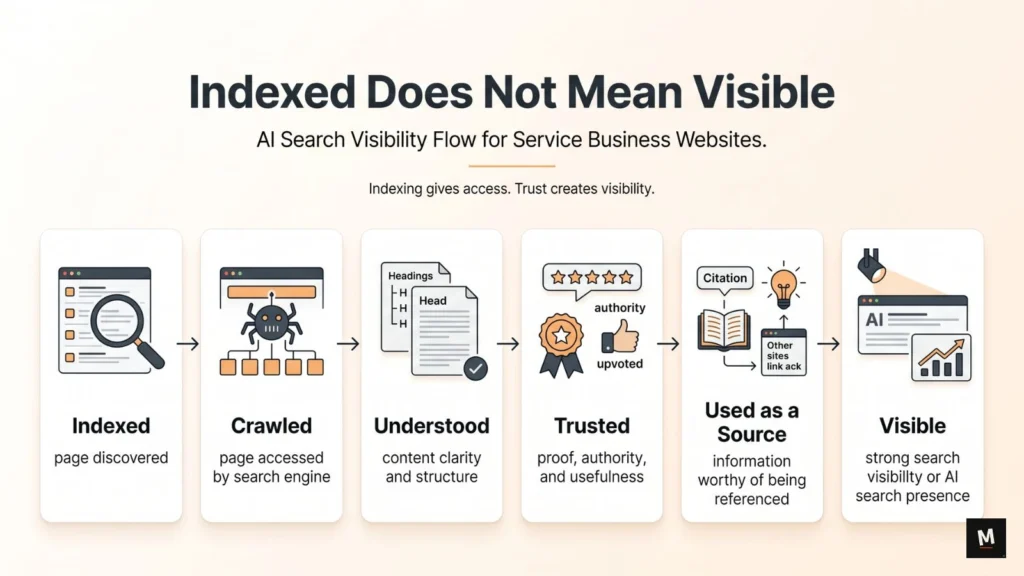
Indexed Does Not Mean Visible
A lot of business owners confuse indexing with visibility.
They publish a page.
They check Google.
The URL appears.
They assume SEO is working.
But indexing is only the first layer.
Indexing means Google has discovered and stored your page. It does not mean the page deserves to rank. It does not mean the page is strong. It does not mean the content is helpful enough for search users. And it does not mean AI-assisted search systems will trust the page enough to use its information.
Indexing is access. Visibility is trust.
This difference is important for service businesses because most service pages are already indexed. The real problem is usually not discovery. The real problem is weak explanation, thin content, missing proof, poor structure, and unclear positioning.
A page can be indexed and still fail because it does not answer enough useful questions.
A page can be indexed and still fail because it sounds like every other service provider.
A page can be indexed and still fail because it does not clearly explain who the service is for, what problem it solves, how the process works, and why the business should be trusted.
That is why modern SEO has moved beyond simple indexation.
What AI Search Visibility Actually Means
AI search visibility means your website content is clear, structured, useful, and trustworthy enough to appear in, influence, or support answers in AI-assisted search experiences.
It is not only about ranking number one.
It includes:
- appearing in AI Overviews
- being understood correctly by search systems
- becoming a trusted source for specific questions
- supporting answer-style results
- helping AI tools understand your business, services, audience, location, and expertise
- building enough topical confidence around your niche
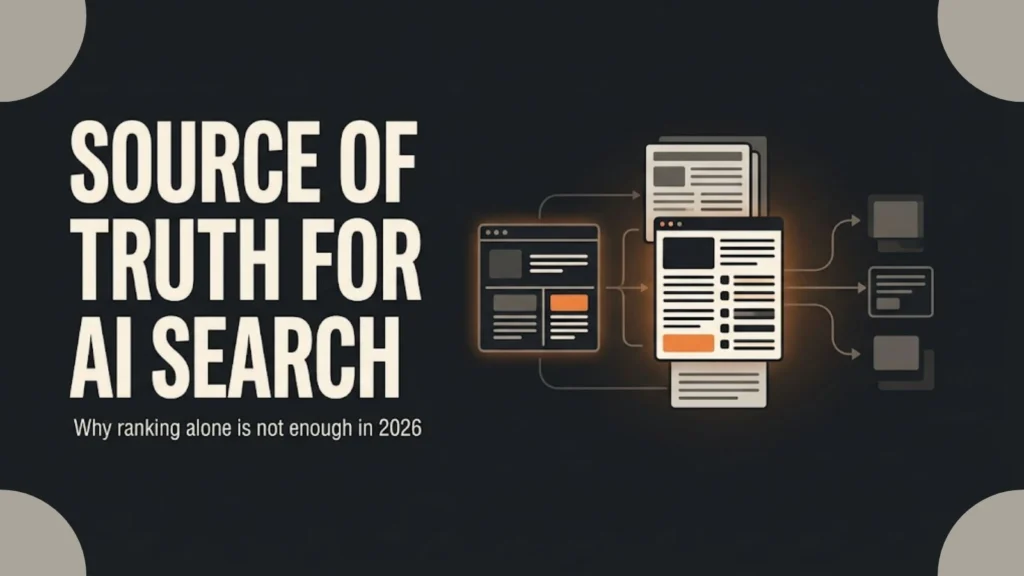
This connects closely with the idea explained in Source of Truth in AI Search. In AI-influenced search, your website should not just be another page on the internet. It should become a reliable source around your subject.
Google’s move to bring AI Mode into Chrome also shows that AI-assisted search is moving closer to the browsing journey itself, not staying limited to a standard results page.
It Is Not Just “Ranking in AI”
Many people talk about “ranking in AI” like it is a simple new trick.
That is the wrong mindset.
AI search visibility is not about finding one hack and applying it everywhere. It is about making your pages easier to understand, verify, summarize, compare, and trust.
For a service business, your website should clearly answer:
- What do you offer?
- Who do you help?
- What problem do you solve?
- What makes your process different?
- Where do you operate?
- What proof do you have?
- What should the user do next?
If your content does not answer these questions clearly, AI search systems have less reason to treat your page as a useful source.
It Is About Being Understandable and Useful Enough to Be Used
| Old SEO Thinking | AI Search Visibility Thinking |
|---|---|
| Get indexed | Get understood |
| Add keywords | Answer real buyer questions |
| Publish more pages | Build clearer source pages |
| Rank one page | Build topic confidence |
| Add generic FAQs | Add useful answer blocks |
| Write for Google | Write for users and search systems together |
AI search visibility is not separate from SEO. It is the next layer of SEO.
Traditional SEO helps search engines find, crawl, and rank your pages.
AI search visibility pushes those pages to become more answer-ready, context-rich, and trustworthy.
If you want to understand the wider AI visibility shift, this also connects with ChatGPT Product Discovery and AI Visibility. Search and discovery are becoming more AI-assisted. Brands need to think beyond standard ranking positions.
Key takeaway: AI search visibility is not about tricking AI systems. It is about making your website easier to understand, verify, and use.
Why This Matters More for Service Businesses
Service businesses have a harder SEO problem than product businesses.
Product businesses usually have clearer information:
- product name
- price
- features
- reviews
- specifications
- comparisons
- availability
- images
- use cases
Service businesses are different.
A service is harder to evaluate. It depends on expertise, process, trust, taste, communication, experience, portfolio, and fit.
That is why service business websites need stronger explanation.
This is especially true for:
- interior designers
- premium design studios
- consultants
- boutique agencies
- clinics
- architects
- legal service providers
- financial consultants
- high-ticket local service brands
Many premium service websites look good visually, but they are weak from a search clarity point of view.
They have beautiful images.
They have elegant fonts.
They have smooth layouts.
But the content does not explain enough.
A beautiful website can impress humans for five seconds. But unclear pages still confuse search systems.
For example, a premium interior design studio may have a polished homepage and strong project images. But if the service page does not explain design style, project type, location, consultation process, budget fit, material selection support, and proof of past work, the page stays weak for search.
The page may look premium.
But it does not give search systems enough context.
That is the gap premium service businesses need to fix.
The Real Problem: Thin Service Pages Cannot Become Trusted Sources
Most service business SEO problems start from weak core pages.
The website may have a homepage, service page, about page, and a few blogs. But the main service pages are often too thin.
Common problems include:
- vague headlines
- generic service descriptions
- no clear audience
- no process explanation
- no proof or examples
- no location clarity
- no pricing or decision guidance
- no useful FAQs
- no internal links to supporting content
- no topical depth around the service
- no clear reason to trust the business
This kind of page can get indexed.
But it will struggle to become visible.
Generic Service Pages Do Not Prove Expertise
A weak service page usually says something like:
“We provide high-quality SEO services to help your business grow online.”
That line says almost nothing.
Who is it for?
What kind of SEO?
What business type?
What problem?
What process?
What outcome?
What proof?
Generic content does not build confidence.
For AI search visibility, your service page needs to be specific. It should explain the service in a way that both a real buyer and a search system can understand.
A stronger version would be:
“We help premium service businesses improve search visibility by fixing unclear service pages, weak content structure, missing internal links, and poor topical authority.”
That is clearer.
It defines the audience.
It defines the problem.
It defines the work.
It gives search systems more context.
Design-Heavy Pages Often Hide Important Search Context
Premium businesses often avoid detailed content because they fear the page will look cluttered.
That fear is understandable.
But the solution is not to remove useful information.
The solution is to structure it better.
A service page can look premium and still explain:
- what the service does
- who it is for
- what problem it solves
- how the process works
- what results are realistic
- what proof supports the claim
- what questions buyers usually ask
Good SEO does not make the page ugly.
Bad SEO makes the page ugly.
Strong SEO makes the page clearer.
This matters even more now because AI search systems need context. If your important information is missing, hidden, vague, or only shown through images, your page becomes weaker.
Random Blog Publishing Does Not Fix Weak Core Pages
Many businesses try to fix weak SEO by publishing more blogs.
That can help, but only when the core pages are already clear.
If your service page is weak, random blog publishing will not solve the real issue.
A blog can support authority.
But the service page still needs to convert and explain.
A blog can attract informational traffic.
But the service page still needs to handle commercial intent.
A blog can answer questions.
But the service page still needs to prove why your business is a serious option.
This is why content strategy should not start with random article ideas.
It should start with core page clarity.
If your website has weak service pages, fix them before scaling content.
Indexed Page vs Trusted Source Page
| Indexed Page | Trusted Source Page |
|---|---|
| Exists in Google | Earns visibility |
| Has basic content | Answers real questions |
| Mentions the service | Explains the service clearly |
| Uses keywords | Builds context |
| Makes generic claims | Shows proof |
| Has weak structure | Uses clear sections |
| Stands alone | Connects to related pages |
| Waits for traffic | Helps users make decisions |
This is the shift service businesses need to understand.
A page does not become valuable because it exists.
It becomes valuable when it helps the user and gives search systems enough reason to trust it.
What Makes a Page Trustworthy for AI Search?
A trustworthy page is not just a long page.
Length alone does not create trust.
A trustworthy page is clear, specific, useful, structured, and supported by proof.
For service businesses, use this framework.
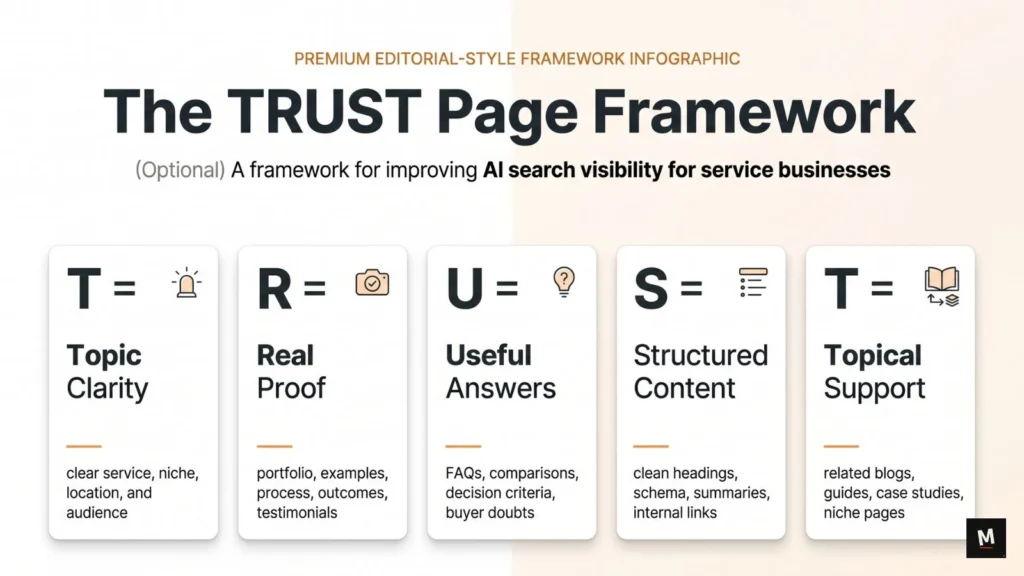
The TRUST Page Framework
| Element | Meaning | What to Add |
|---|---|---|
| T | Topic clarity | Clear service, niche, location, and audience |
| R | Real proof | Portfolio, examples, process, outcomes, testimonials |
| U | Useful answers | FAQs, comparisons, decision criteria, buyer doubts |
| S | Structured content | Clean headings, schema, summaries, internal links |
| T | Topical support | Related blogs, guides, case studies, niche pages |
Topic Clarity
Your page should make the topic obvious.
Do not make users guess what you do.
A clear service page should explain:
- the exact service
- the target audience
- the business type
- the location, if relevant
- the problem being solved
- the expected direction of improvement
For example:
“SEO for interior designers” is clearer than “digital growth solutions.”
“SEO visibility sprint for premium service businesses” is clearer than “online marketing audit.”
Clarity helps users.
It also helps search systems.
Real Proof
A service page without proof feels weak.
Proof can come in different forms:
- portfolio examples
- before-and-after screenshots
- case studies
- client type examples
- process screenshots
- testimonials
- industry experience
- specific audit observations
- real project learnings
Proof is not only about showing big numbers.
For premium service businesses, proof can also mean showing judgment.
An interior designer does not only need to show finished rooms. They can explain design decisions, space planning logic, client challenges, and project constraints.
That type of explanation builds expertise.
The same applies to SEO. Do not only say “we improve rankings.” Explain what you diagnose, how you prioritize, and why certain fixes matter.
Useful Answers
AI search visibility improves when your page answers real questions.
Not fake SEO FAQs.
Real buyer questions.
For service businesses, useful questions may include:
- Who is this service best for?
- How does the process work?
- How long does it take?
- What affects pricing?
- What makes this different from cheaper providers?
- What should the client prepare before starting?
- What are common mistakes?
- What results are realistic?
- When is this service not a good fit?
These questions make the page more helpful.
They also make the page more answer-ready.
That is important for AEO, GEO, and AI-assisted search.
Structured Content
A strong page should not be a wall of text.
It should have clear sections.
Use:
- clear H2s
- useful H3s
- short answer blocks
- comparison tables
- process sections
- proof sections
- FAQ sections
- internal links
- relevant structured data
- concise summaries
Structure helps readers scan the page.
It also helps search systems understand the page.
This is where many service websites fail. They either write too little or write everything in a vague, unstructured way.
Both create problems.
Topical Support
One strong service page is useful.
But one service page alone is usually not enough.
Search systems build confidence by seeing repeated clarity across your website.
That means your main service page should be supported by related content.
For example, if your main topic is SEO visibility for service businesses, supporting content can include:
- service page SEO guides
- AI Overviews explainers
- content structure articles
- internal linking guides
- website clarity audits
- niche-specific SEO pages
- case studies
- comparison articles
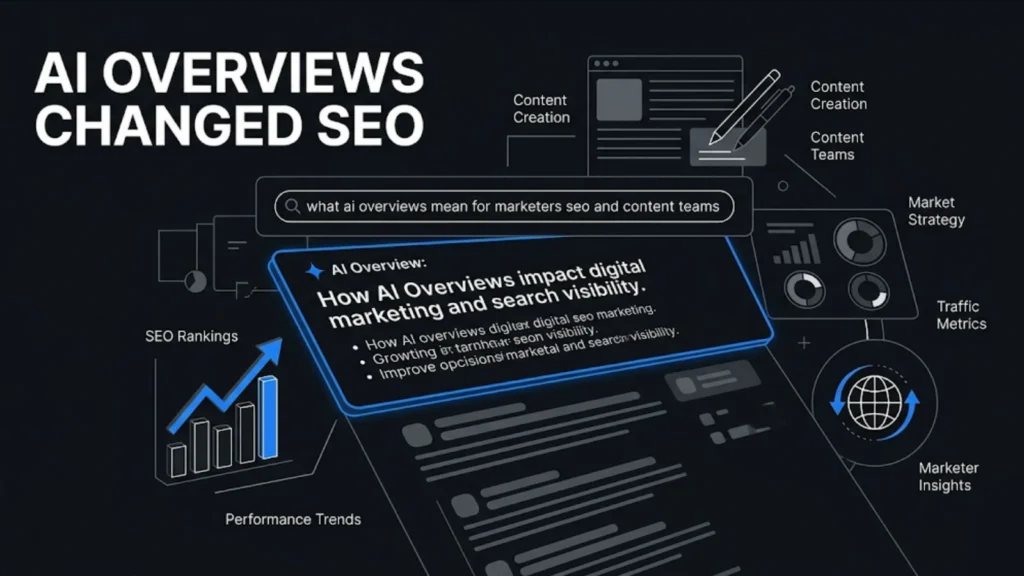
This is why your article on AI Overviews for Marketers and SEO Content Teams should internally support this topic. Both articles sit in the same modern SEO visibility cluster.
Key takeaway: AI search visibility does not come from one optimized page. It comes from repeated clarity across your website.
How Service Businesses Should Structure Pages for AI Search Visibility
A service page should not be built like a brochure.
It should be built like a decision page.
The goal is not to dump every detail. The goal is to guide the visitor and help search systems understand the service properly.
A strong service page should include these sections:
| Page Element | Why It Helps AI Search Visibility | Example |
|---|---|---|
| Clear H1 | Defines the main service topic | SEO Consultant for Service Businesses |
| Short service definition | Gives answer-ready clarity | “This service helps premium service businesses improve organic visibility…” |
| Problem section | Matches buyer pain | “Your website looks premium but does not rank.” |
| Audience section | Clarifies fit | Interior designers, consultants, boutique service providers |
| Process section | Shows expertise | Audit → Structure → Fix → Measure |
| Proof section | Builds trust | Case studies, examples, screenshots |
| Comparison section | Supports decision-making | Sprint vs audit vs retainer |
| FAQ section | Answers real buyer questions | Timeline, pricing, scope, results |
| Internal links | Builds topical connection | Link to related SEO and AI search articles |
| CTA | Gives next step | Book a visibility review |
Start With a Direct Service Definition
Every service page should quickly explain what the service is.
Do not start with vague branding language.
A weak opening:
“We help brands unlock their digital potential through innovative strategies.”
A better opening:
“We help premium service businesses improve organic visibility by fixing unclear service pages, weak content structure, poor internal linking, and missing topical authority.”
The second version gives more context.
It tells the user what you do.
It tells search systems what the page is about.
It makes the offer easier to understand.
Explain the Buyer Problem Before Selling the Service
Most service pages sell too early.
They say:
“Contact us today.”
But they have not explained the problem properly.
For service businesses, the problem section matters because buyers need to feel understood.
Example:
“Many premium service websites look strong visually but fail in search because the core pages do not explain services clearly. The website has design quality, but not enough search context.”
That is specific.
It speaks to the exact problem.
It also fits premium interior designers and design studios, where visual quality is often high but SEO structure is weak.
Add Proof Before Making Claims
Do not make big claims without support.
If you say you improve visibility, show how.
Proof can include:
- screenshots
- audit examples
- before-and-after content structure
- sample internal linking improvements
- page-level recommendations
- niche observations
- project examples
For MayankUnfiltered, this matters because the brand voice is judgment-led. It should not sound like generic agency copy.
A strong page should show how you think.
That is also useful for AI search visibility because expert-led explanation creates more trustworthy content.
Answer Comparison and Decision Questions
Buyers compare options before contacting a service provider.
Your page should help them compare.
For example:
- SEO audit vs SEO visibility sprint
- SEO consultant vs SEO agency
- service page optimization vs blog publishing
- local SEO vs organic SEO
- AI search optimization vs traditional SEO
Comparison sections are powerful because they match real decision behavior.
They also help answer surfaces because search systems often need clear comparative information.
Read More:-
- Source of Truth in AI Search for deeper AI search trust thinking
- AI Overviews for Marketers and SEO Content Teams for Google AI visibility context
- ChatGPT Product Discovery and AI Visibility for AI discovery behavior
- AI Customer Journey Mapping 2026 for understanding how user journeys are changing
- AI Lead Generation Without Killing Lead Quality for connecting visibility with lead quality
If your service pages are indexed but still not bringing visibility, the issue may not be keywords. It may be page clarity, proof, structure, and internal linking. That is exactly what an SEO Visibility Sprint should diagnose first.
The Content Service Businesses Should Build Around Core Pages
Service businesses should stop publishing random blogs.
Random content creates noise.
Useful content builds support around core pages.
If your main service page is about SEO visibility for service businesses, your supporting content should answer questions around that decision.
Good supporting content includes:
- problem-aware articles
- comparison articles
- pricing or cost explainers
- mistake articles
- checklist articles
- niche-specific landing pages
- local SEO pages
- case studies
- process explainers
- FAQ-style guides
For an interior design SEO cluster, supporting articles could include:
- Why Interior Design Websites Do Not Rank
- SEO for Interior Designers: What Actually Matters
- Interior Designer Website SEO Checklist
- How to Structure an Interior Design Service Page
- Local SEO for Interior Design Studios
- Portfolio SEO for Interior Designers
- Why Beautiful Websites Still Fail in Search
Each article should support the main money page.
That is how topical authority is built.
Do not publish random blogs. Publish support pages that make your core service page easier to trust.
This is also why content growth and AI marketing should not be treated separately. Your article on AI Marketing Workflow for Small Business can support broader business visibility thinking, but the SEO cluster still needs strong service-specific pages.
What to Measure Beyond Rankings
Rankings still matter.
But they are not enough.
If search is becoming more AI-assisted, service businesses need to measure visibility from multiple angles.
| Metric | What It Tells You |
|---|---|
| Search Console performance data | Whether search visibility is expanding |
| Query variety | Whether Google understands more topics around your business |
| CTR | Whether your search message is strong enough |
| Average position | Whether ranking direction is improving |
| Non-branded clicks | Whether new users are discovering you |
| Branded search | Whether trust and recall are growing |
| Leads or enquiries | Whether visibility is creating business impact |
| Internal link clicks | Whether users are moving through the website |
| Engagement on service pages | Whether the page answers enough questions |
| Assisted conversions | Whether content supports lead generation |
The goal is not to worship rankings.
The goal is to understand whether the website is becoming easier to discover, understand, trust, and contact.
For service businesses, especially premium ones, traffic alone is not the final goal.
Qualified visibility is the goal.
A page that brings the wrong audience is not successful.
A page that attracts fewer but more relevant visitors can be more valuable.
This connects with the thinking in AI Lead Generation Without Killing Lead Quality. More visibility is useful only when it attracts the right type of lead.
The Wrong Way to Optimize for AI Search
AI search optimization is already becoming a buzzword.
That means people will try shortcuts.
Most of them will not work for long.
Avoid these mistakes:
- stuffing “AI search visibility” everywhere
- publishing thin AI-generated blogs
- adding fake FAQ sections
- copying competitor headings without understanding intent
- using schema without useful content
- treating GEO as a magic hack
- writing for bots and forgetting real buyers
- creating pages with no proof
- hiding important service details behind design elements
- publishing volume without improving core pages
AI search optimization is not a shortcut around weak content. It exposes weak content faster.
The wrong question is:
“How do I trick AI search?”
The better question is:
“How do I make this page genuinely useful, specific, structured, and trustworthy?”
That question leads to better SEO.
It also leads to better business pages.
Practical AI Search Visibility Checklist for Service Businesses
Before publishing more content, check your existing service pages.
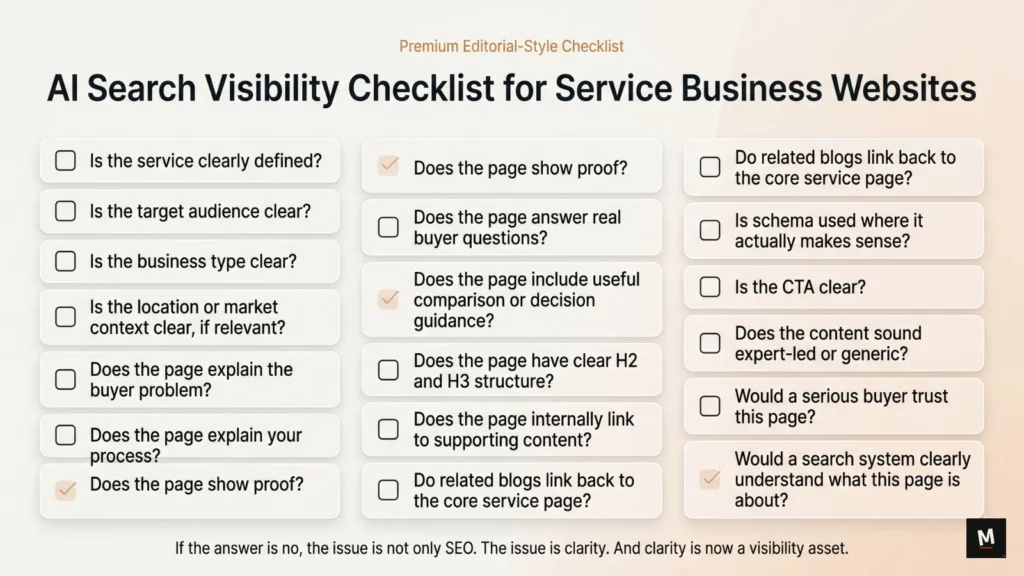
Use this checklist:
- Is the service clearly defined?
- Is the target audience clear?
- Is the business type clear?
- Is the location or market context clear, if relevant?
- Does the page explain the buyer problem?
- Does the page explain your process?
- Does the page show proof?
- Does the page answer real buyer questions?
- Does the page include useful comparison or decision guidance?
- Does the page have clear H2 and H3 structure?
- Does the page internally link to supporting content?
- Do related blogs link back to the core service page?
- Is schema used where it actually makes sense?
- Is the CTA clear?
- Does the content sound expert-led or generic?
- Would a serious buyer trust this page?
- Would a search system clearly understand what this page is about?
If the answer is no, the issue is not only SEO.
The issue is clarity.
And clarity is now a visibility asset.
FAQ: AI Search Visibility for Service Businesses
What is AI search visibility?
AI search visibility means your website content is clear, trustworthy, and useful enough to appear in, influence, or support answers in AI-assisted search experiences.
Is indexing enough for SEO?
No. Indexing only means search engines can access your page. It does not guarantee ranking, traffic, trust, AI visibility, or leads.
How can service businesses improve AI search visibility?
Service businesses can improve AI search visibility by building clear service pages, answering real buyer questions, adding proof, improving internal links, using structured content, and supporting core pages with relevant content clusters.
What makes a service page trustworthy?
A trustworthy service page clearly explains the service, audience, problem, process, proof, FAQs, and next step.
Is AI search optimization different from SEO?
It is not completely separate from SEO. AI search optimization is an added layer where your content needs to be more answer-ready, structured, contextual, and trustworthy
Final Takeaway: Build Pages That Deserve to Be Used as Sources
Indexing is basic.
Ranking is useful.
But trust is becoming the next layer.
Service businesses cannot rely on thin pages, generic copy, and random blogs anymore.
Modern SEO needs clearer source pages.
A strong page should explain the service, prove expertise, answer buyer questions, support decisions, connect to related content, and guide the user toward the next step.
The businesses that win in modern search will not be the ones publishing the most.
They will be the ones explaining the clearest.
If your website looks premium but search visibility is weak, the first step is not publishing more blogs.
The first step is checking whether your core pages are clear enough to be trusted.
Before publishing more content, audit whether your core pages are clear enough to be trusted. That is the first layer of modern SEO visibility.