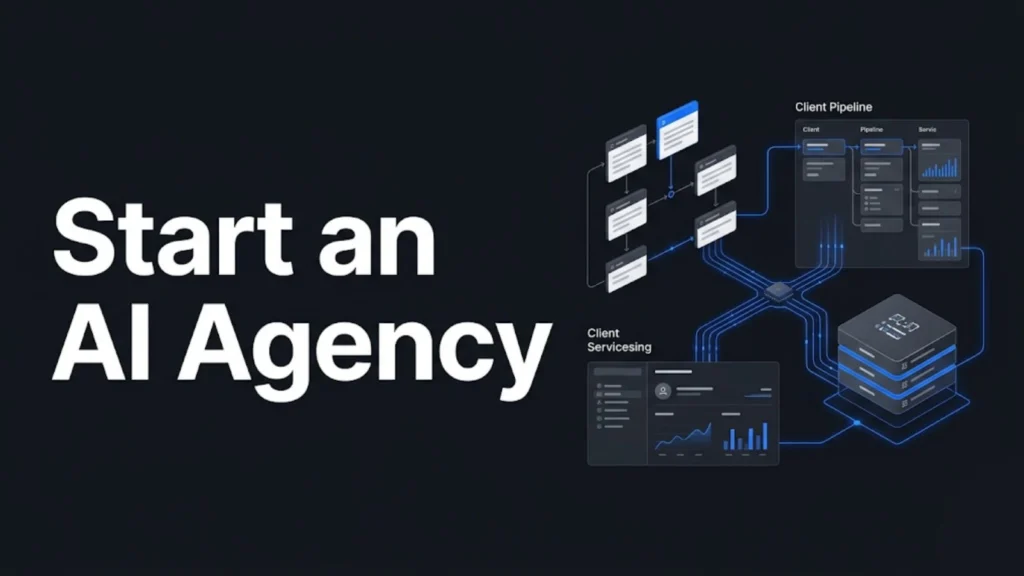
Starting an AI marketing agency sounds attractive because the market is full of noise around automation, content, workflows, and faster execution. But most people entering this space are confused about one basic thing: what are they actually selling?
An AI marketing agency is not a prompt-selling business. It is not a tool-reselling business either. It is still a service business. The difference is that AI helps you deliver faster, structure work better, and improve output quality when used correctly.
This guide explains how to choose a niche, package offers, build a lean delivery model, avoid fake promises, and get your first clients with a practical system.
What an AI Marketing Agency Actually Is
An AI marketing agency is a service business that uses AI as a backend leverage layer to improve execution.
That means:
- you are not selling AI by itself
- you are not selling prompts as the main offer
- you are not just giving tool recommendations
- you are selling marketing outcomes supported by systems, workflows, and human judgment
A real AI marketing agency helps clients get work done better in areas like:
- content production
- SEO execution
- ad creative support
- reporting workflows
- competitor research
- automation setup
- campaign planning
The important shift is simple: clients do not care that you use AI. They care that you help them move faster, reduce chaos, and get better marketing output.
Read More:- AI Marketing in 2026: Complete Business Guide to Strategy, SEO, Content, and Ads
Why Most New AI Agencies Will Fail
Most new AI agencies will fail for boring reasons, not technical ones.
1. No niche
They try to serve everyone, so their positioning becomes weak.
2. No clear offer
They say things like “we do AI marketing solutions,” which sounds vague and hard to trust.
3. Too many services
They try to do SEO, ads, social media, funnels, email, automation, branding, and web development from day one.
4. Overpromising automation
They pitch fully automated growth systems that are unrealistic.
5. Weak execution quality
AI speeds up drafts, but weak thinking still creates weak output.
6. No operating system
They have tools, but no workflow, no SOPs, and no quality control.
The market does not reward people for using AI. It rewards people who use it to deliver better work.
How to Choose a Niche
Niche selection is where your agency becomes easier or harder to build.
There are three practical ways to niche down.
1. Industry niche
You serve a specific type of business.
Examples:
- dentists
- SaaS companies
- real estate firms
- local service businesses
- ecommerce brands
This works well because messaging becomes easier and proof compounds faster.
2. Service niche
You focus on one clear service area.
Examples:
- SEO content systems
- paid ad creative support
- local SEO setup
- reporting automation
- funnel copy and email sequences
This works well if your skill is stronger than your industry knowledge.
3. Problem-based niche
You solve one repeated business problem.
Examples:
- low content velocity
- weak ad testing pipeline
- poor lead follow-up
- messy reporting
- inconsistent SEO publishing
This is often the smartest model because clients buy solutions to pain, not categories.
Best niche logic for beginners
If you are just starting, use this filter:
- choose a niche where businesses already spend money
- choose a service tied to measurable outcomes
- choose a problem that happens repeatedly
- choose an area where AI can improve speed without hurting quality too much
Good beginner examples:
- SEO support for local businesses
- AI-assisted content systems for B2B teams
- ad creative support for ecommerce brands
- reporting and workflow automation for small agencies
Do not choose a niche just because it sounds trendy. Choose one where you can explain the problem clearly and deliver repeatable work.
How to Structure Your Offer
Most beginners make their offer too broad. The smarter move is to create a small set of clear offers.
Option 1: Done-for-you
You handle the execution.
Examples:
- monthly SEO content production
- blog optimization and internal linking
- ad creative ideation and testing support
- reporting dashboards and summaries
Best for clients who want results without managing the process.
Option 2: Done-with-you
You guide the client’s internal team.
Examples:
- content workflow setup
- SEO process design
- AI SOP creation
- campaign planning support
Best for businesses with internal marketers who need systems.
Option 3: Audit and strategy
You diagnose problems and give a roadmap.
Examples:
- AI content workflow audit
- SEO system audit
- marketing automation gap analysis
- ad creative process audit
Best when you want a lower-delivery, higher-thinking offer.
Option 4: Implementation support
You help the client apply the roadmap over a short period.
Examples:
- 30-day implementation sprint
- SOP rollout
- content operations setup
- prompt library plus workflow training
Retainer vs project-based
Use project-based pricing when:
- you are doing setup work
- the scope has a clear end
- trust is low and the entry barrier needs to stay low
Use a retainer when:
- the work is recurring
- the client needs ongoing execution
- your workflow can repeat monthly
The key is simple: do not sell “AI services.” Sell a clear outcome with a clear process.
Read More:- AI Marketing vs Traditional Digital Marketing: What Actually Changes?
What Services You Can Deliver Using AI
AI can support many parts of marketing work, but not every service should be positioned as AI-first.
The better framing is outcome-first.
Services that fit well
- content research and briefing
- SEO content production support
- content refresh workflows
- ad copy ideation
- landing page draft support
- competitor analysis summaries
- reporting support
- internal SOP documentation
- automation setup for repetitive marketing tasks
Better framing examples
Weak:
- AI content creation service
Better:
- monthly SEO content production system for B2B brands
Weak:
- AI reporting tool support
Better:
- weekly marketing reporting summaries and decision dashboards
Weak:
- AI ad copy service
Better:
- faster ad testing system for ecommerce campaigns
That difference matters because clients understand outcomes better than tools.
How to Deliver Without Building a Bloated Team
One of the biggest mistakes new founders make is trying to build a full agency team too early.
You do not need that.
A lean model can work like this:
Core team structure
- Founder / operator: strategy, sales, client communication, QA
- Writer / editor or specialist: content execution or service-specific work
- Designer optional: visuals, creatives, presentation assets
- Automation support optional: workflow setups when needed
That is enough for many early-stage agencies.
What makes this model work
- narrow offer
- clear SOPs
- repeatable workflow
- quality review at the founder level
- limited client volume in the beginning
Do not hire people to compensate for unclear offers. Fix the offer first.
Read More:- Best AI Marketing Tools for Content, SEO, and Ads
Where AI Actually Helps in Delivery
This is where practical thinking matters. AI is useful in delivery, but only in the right layers.
Where AI helps most
- speeding up research synthesis
- organizing messy notes into useful structure
- creating first drafts
- turning inputs into clearer briefs
- documenting workflows
- summarizing meetings and reports
- generating ideas for testing
- reducing repetitive manual writing
Where human review still matters most
- strategy
- positioning
- audience relevance
- fact-checking
- quality control
- final messaging decisions
- client communication
The strongest AI agencies are not the ones using AI for everything. They are the ones using AI for the messy middle: research, drafting, structure, summarization, and process support.
What You Should Never Promise
This section matters because bad promises destroy trust fast.
Never promise:
- fully automated marketing
- instant SEO rankings
- zero human involvement
- unlimited content with guaranteed quality
- AI-driven growth with no strategy
- complete replacement of marketers or writers
- perfect automation from day one
These promises attract attention, but they create the wrong buyers and the wrong expectations.
A smarter positioning line is this:
We use AI to improve speed, consistency, and execution quality. Human strategy and review stay essential.
How to Get Your First Clients
Most new agency founders overthink this part. Your first clients usually come from sharp positioning plus a small, credible offer.
1. Start with niche-based positioning
Do not say:
- we help businesses with AI marketing
Say:
- we help local service businesses build a faster SEO content workflow
- we help ecommerce brands improve ad creative testing speed
- we help small teams build AI-assisted reporting systems
2. Create one clear starter offer
Examples:
- 14-day AI content workflow setup
- SEO content process audit for local businesses
- ad creative system sprint for ecommerce brands
- reporting automation starter package
A small entry offer is easier to buy than a broad monthly retainer.
3. Build authority content
Write content that proves your thinking.
Examples:
- how a local business can use AI in SEO without hurting quality
- what most companies get wrong about AI content workflows
- how to reduce reporting chaos with simple automation
This attracts the right type of client because it shows how you think.
4. Use outbound with sharp positioning
Your outreach should focus on the problem, not the tool.
Bad outreach:
- We help companies use AI for marketing
Better outreach:
- I noticed your team publishes content inconsistently. We help small teams build a cleaner SEO content workflow using AI-assisted research, briefs, and SOPs.
5. Use case-study substitutes if you lack proof
If you have no client results yet, use:
- teardown-style content
- sample workflows
- mini audits
- before-and-after mock systems
- your own process documentation
Early proof does not always need to be client logos.
6. Offer a small test project
A low-risk first step helps win trust.
Examples:
- one workflow audit
- one content sprint
- one automation setup
- one reporting system cleanup
Read More:- Claude AI for Marketers: 7 Practical Workflows That Save Hours Every Week
Tools and Systems You Need Early
You do not need a huge software stack. You need a simple operating system.
Early essentials
- AI writing and research tools
- project management tool
- SOP documentation system
- reporting templates
- communication workflow
- file organization system
What matters more than the exact tool
- can your process repeat?
- can someone else follow it?
- can quality be reviewed quickly?
- can handoffs happen without chaos?
The tool matters less than the workflow behind it.
A Lean AI Agency Model That Can Actually Work
Here is a practical early-stage model.
Simple operating structure
Step 1: Pick one niche
Example: local businesses, B2B service brands, ecommerce stores
Step 2: Pick one service line
Example: SEO content systems, ad creative support, reporting automation
Step 3: Build one core offer
Keep it outcome-led and easy to explain.
Step 4: Create SOPs for delivery
Research → brief → draft → review → finalize → report
Step 5: Add one support layer only
Do not stack five extra services too early.
Step 6: Build proof through content and small wins
Case studies, process examples, audits, and visible expertise
Why this model works
- simpler sales
- easier delivery
- better quality control
- faster process improvement
- less team bloat
- stronger positioning
This is the opposite of most “AI agency dream” content online, but it is far more realistic.
Common Mistakes and Gaps
These are the mistakes that quietly weaken new agencies.
Mistake 1: Selling tools instead of outcomes
Clients do not want AI workflows. They want a better content pipeline, better creative velocity, or better reporting clarity.
Mistake 2: Copying big agency positioning
If you are small, do not pretend to be a full-stack enterprise partner.
Mistake 3: Starting with too many offers
Too many offers make sales harder and delivery messier.
Mistake 4: Confusing speed with quality
AI can increase volume fast. That does not guarantee useful output.
Mistake 5: No quality control layer
Without review, AI-assisted delivery can damage credibility.
Mistake 6: Weak offer packaging
If your offer sounds vague, the buyer will compare you on price.
Actionable Steps to Start This Week
Use this sequence:
- choose one niche you understand or can study fast
- pick one repeatable service problem to solve
- write one offer in plain language
- create one delivery SOP from start to finish
- build one sample asset, audit, or workflow example
- publish one authority article around that niche problem
- send focused outbound messages to a small, relevant list
- close one small project before trying to scale
The goal is not to launch a big agency. The goal is to build one clear service system that can sell and deliver.
Conclusion
Starting an AI marketing agency in 2026 is not about selling hype, prompts, or automation fantasies. It is about building a small, outcome-focused service business that uses AI as leverage.
The agencies that will win are not the loudest ones. They are the ones with clear positioning, narrow offers, usable systems, and strong quality control.
Do not sell AI as the product. Sell better marketing execution with AI supporting the backend.
Frequently Asked Questions
What is an AI marketing agency?
An AI marketing agency is a service business that uses AI to improve marketing execution, speed, workflow, and output quality. It is not just a prompt-selling or tool-reselling business.
How do I choose a niche for an AI agency?
Choose based on one of three angles: industry, service, or problem. The best beginner model is usually a niche where businesses already spend money and where the problem is repeated and easy to explain.
Can I start an AI marketing agency without a big team?
Yes. A lean model with a founder, one specialist, simple SOPs, and strong review can work well early on.
What should an AI marketing agency never promise?
It should never promise fully automated marketing, instant rankings, zero human involvement, or unlimited high-quality output without review.
How do I get my first clients for an AI marketing agency?
Use sharp positioning, one clear starter offer, authority content, focused outbound, and small test projects to reduce buyer risk.