Most “best AI marketing tools” articles fail for one reason: they dump 20 tools into a random list without explaining which one fits your actual workflow. That is useless if your real question is simple: which tool should you use for content, SEO, ads, or automation without wasting money?
This guide solves that by grouping tools based on work, not hype. You will see where each tool fits, where it overlaps with others, and which stack makes sense if you are a beginner, solo operator, content-led brand, or performance team.
The goal is not to find the most famous AI tool. The goal is to choose a stack that helps you produce better work faster.
How to Choose AI Marketing Tools
Before picking any tool, start with the job you need done.
A good AI marketing stack should answer four questions:
- Does it help create better output, or just faster output?
- Does it improve decision-making, or only generation?
- Does it fit one workflow deeply, or many workflows loosely?
- Does it save enough time or improve enough performance to justify the cost?
That is where most buyers go wrong. They choose a tool because it looks impressive in demos.
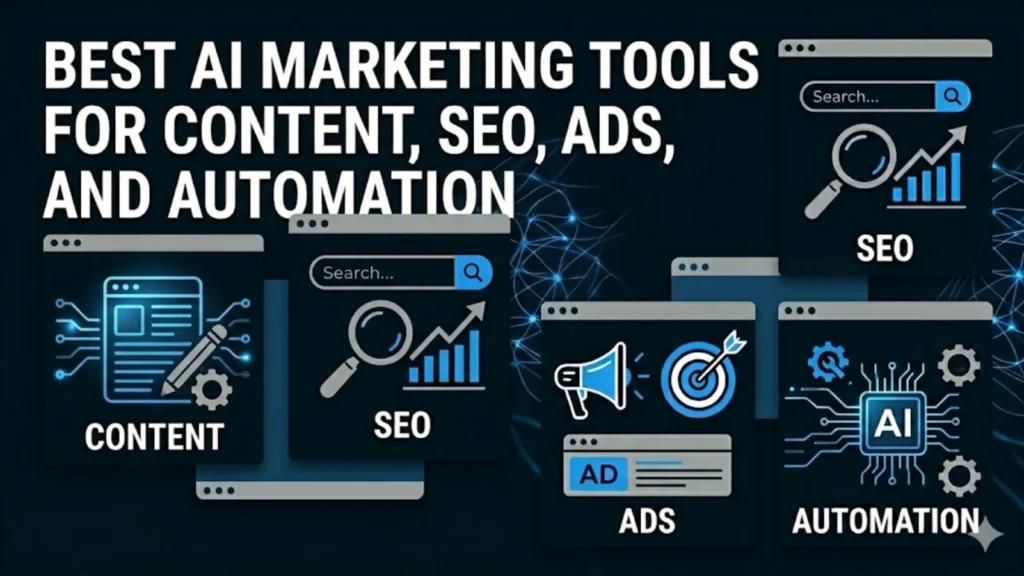
In practice, AI marketing tools usually fall into four roles:
- creation tools for writing, visuals, and campaign assets
- optimization tools for SEO, content quality, and research
- performance tools for ad creatives, testing, and paid growth execution
- workflow tools for automation, handoffs, and orchestration
If a tool does not clearly fit one of those roles, it usually becomes shelfware.
What to Evaluate Before Buying
Use these filters:
- primary use case: content, SEO, ads, or automation
- team type: solo creator, in-house marketer, agency, or enterprise
- depth vs breadth: one best-in-class tool is often better than one “does-everything” platform
- human control: the best tools assist judgment, not replace it
- integration value: tools get stronger when they connect with your CMS, CRM, analytics, and workflow stack
Read More:- AI Marketing in 2026: Complete Business Guide to Strategy, SEO, Content, and Ads
Best AI Tools for Content
1. Jasper
Jasper is strongest for teams that need marketing content at scale with brand consistency. It is no longer just a text generator. Its value is in marketing workflows, shared governance, and more structured content production.
Best for:
- content teams
- agencies
- brands publishing at scale
- teams that care about brand voice consistency
Why it stands out:
- built specifically for marketers
- supports campaign creation, SEO, personalization, and content workflows
- stronger governance than many general-purpose AI tools
Where it falls short:
- overkill for solo beginners
- works best when you already have process and publishing volume
2. Canva Magic Studio
Canva is no longer just a design tool. Magic Studio makes it useful for presentations, visuals, social assets, and marketing design workflows.
That makes it a practical choice for marketers who need content assets, not just written copy.
Best for:
- marketers creating blog visuals, social creatives, lead magnets, and ad assets
- small businesses without dedicated designers
Why it stands out:
- easy asset production
- strong for non-designers
- useful across content marketing and paid social creative workflows
Where it falls short:
- not a deep SEO or research tool
- better for execution than strategy
3. HubSpot Breeze
HubSpot Breeze is most useful when content work is tied to CRM, lead generation, and campaign execution. Its main advantage is context. It can work inside HubSpot’s ecosystem and use business data instead of generating content in isolation.
Best for:
- businesses already using HubSpot
- teams that want content and campaign support connected to CRM data
Why it stands out:
- AI support with business context
- useful for content, campaign planning, and operational marketing work
Where it falls short:
- highest value comes inside the HubSpot ecosystem
- less attractive if you do not already use HubSpot
Best AI Tools for SEO
1. Surfer
If your goal is to create and optimize SEO content faster, Surfer is one of the clearest choices. It has grown from a content score tool into a broader SEO workflow platform.
Best for:
- content-led SEO teams
- niche site builders
- agencies producing blog content at scale
Why it stands out:
- strong content optimization workflow
- useful for topical planning and search visibility
- good fit for writers who need structure, not just text generation
Where it falls short:
- less comprehensive for full SEO research than all-in-one suites
- works best when paired with a deeper research platform
2. Semrush
Semrush is one of the strongest options if you want breadth. It covers keyword research, competitor analysis, reporting, SEO, advertising, content workflows, and growing AI visibility features.
Best for:
- marketers who want one platform for SEO plus adjacent channels
- agencies and in-house teams managing multiple workflows
Why it stands out:
- strong all-around data environment
- better for research and planning than many content-only AI tools
- useful when SEO overlaps with ads, reporting, and market intelligence
Where it falls short:
- can feel heavy for beginners
- may be hard to justify if you are not using enough of the platform
3. Ahrefs
Ahrefs remains one of the best tools for search-focused marketers who want strong data, competitor analysis, and content gap insights.
Best for:
- SEO-first operators
- content teams that care about search demand and competitive depth
- publishers building authority clusters
Why it stands out:
- strong search intelligence
- helpful for topical coverage and gap finding
- good fit for editorially serious SEO
Where it falls short:
- less of a full AI marketing workflow platform
- best value comes when you already know how to use search data well
Read More:- What Is AI Marketing and How Does It Actually Work?
Best AI Tools for Ads and Performance
1. AdCreative.ai
For paid media teams, AdCreative.ai is one of the clearest tools in this category. Its value proposition is simple: generate ad creatives, copy, images, and video variations faster to support performance testing.
Best for:
- performance marketers
- ecommerce brands
- agencies running many creative variations
Why it stands out:
- built specifically for ad creative production
- useful when creative velocity is the bottleneck
- stronger fit for paid media than generic AI writers
Where it falls short:
- better at production than strategy
- still needs human messaging judgment and testing discipline
2. HubSpot for Ad Support
HubSpot also offers AI support for advertising and campaign asset generation, especially for teams already working inside its platform. Its main strength is workflow connection, not creative specialization.
Best for:
- small to mid-sized teams already using HubSpot
- marketers who need quick ad drafts without adding another dedicated tool
Why it stands out:
- simple entry point
- useful when campaigns are tied to CRM and funnel operations
Where it falls short:
- not as specialized as a dedicated ad-creative platform
3. Canva for Paid Creative Support
Canva belongs in this section too because many teams use it to turn AI-generated ideas into ad-ready formats quickly. It is especially useful for resizing, templating, and moving from concept to publishable asset.
Best for:
- small paid media teams
- founders running their own ads
- fast creative iteration
Best AI Tools for Workflow and Automation
1. Zapier
Zapier is one of the most practical workflow tools because it sits between systems. Its value is not that it writes better than a specialist tool. Its value is that it connects tools, triggers actions, routes data, and turns disconnected AI usage into real workflows.
Best for:
- automation of content workflows
- lead routing
- marketing ops
- connecting forms, CRM, sheets, email, project management, and AI tools
Why it stands out:
- huge app ecosystem
- good for turning one-off tasks into repeatable systems
- useful for content approvals, publishing, notifications, and lead handling
Where it falls short:
- not a strategy tool
- bad workflows automated are still bad workflows
2. HubSpot
HubSpot also deserves a place here because its AI layer is embedded into a broader operating system for marketing. If your workflows depend on CRM context, lead management, email, and campaign execution, HubSpot can deliver more value than a collection of point tools.
Best for:
- teams that want marketing execution and automation in one place
- businesses already using HubSpot as the operating layer
A Simple System to Pick the Right AI Marketing Stack
This is where most readers need clarity. Do not build your stack by buying one content tool, one SEO tool, one ads tool, and one automation tool just because the categories exist.
Build it in this order.
Stage 1: Pick Your Core Growth Motion
Choose one:
- content-led growth
- SEO-led growth
- paid acquisition
- ops and automation efficiency
Stage 2: Choose One Primary Tool Per Motion
Examples:
- content-led: Jasper or Canva
- SEO-led: Surfer, Ahrefs, or Semrush
- paid-led: AdCreative.ai
- ops-led: Zapier or HubSpot
Stage 3: Add Only One Support Layer
Examples:
- Jasper + Surfer
- Ahrefs + Canva
- AdCreative.ai + Canva
- Semrush + Zapier
Stage 4: Check Overlap Before Adding More
Do not pay twice for:
- content generation
- keyword research
- reporting
- workflow automation
That is the real system. The best stack is usually small, connected, and role-based.
Read More:- AI Marketing vs Traditional Digital Marketing: What Actually Changes?
Which Tool Stack Makes Sense for Beginners
If you are just starting, do not copy enterprise stacks.
Best Beginner Stack for Content and SEO
- Canva for visuals and simple asset creation
- Surfer for content structure and on-page optimization
- Ahrefs or Semrush for search research, depending on budget and workflow depth
Best Beginner Stack for Ads
- AdCreative.ai for ad asset generation
- Canva for polishing and resizing creatives
- Zapier only when workflow volume increases
Best Beginner Stack for All-Round Marketing
- Semrush if you want broader marketing visibility
- Canva for fast execution
- Zapier later for process automation
Best Stack for Teams With CRM-Led Growth
- HubSpot Breeze
- Canva
- Zapier when external tool orchestration becomes necessary
Common Mistakes People Make With AI Marketing Tools
Buying Too Many Tools Too Early
Most teams do not have a tool problem. They have a workflow problem.
Using AI to Produce More Instead of Producing Better
More content does not mean better rankings. More ad variants do not mean better ROAS.
Expecting One Tool to Solve Everything
General-purpose platforms look attractive, but specialists often win in execution.
Ignoring Integration and Handoff Friction
A tool is not efficient if the output still needs manual copying across five systems.
Replacing Judgment With Generation
Even the best AI marketing tools still need human decisions on positioning, messaging, audience, and quality control.
Actionable Steps to Choose the Right Tool This Week
Follow this process:
- list your top three recurring marketing tasks
- mark which ones are creation, optimization, performance, or automation
- pick one tool that solves the biggest bottleneck
- run it for a real workflow, not a demo
- measure time saved, output quality, and business impact
- add a second tool only if it removes a clear gap
That gives you a stack built around work, not noise.
Conclusion
The best AI marketing tools are not the ones with the loudest branding. They are the ones that fit your workflow, reduce friction, and improve actual outcomes.
If your work is content-heavy, Jasper and Canva are strong starting points. If your growth depends on SEO, Surfer, Semrush, and Ahrefs are more useful than generic writing tools. If you run paid campaigns, AdCreative.ai can speed up creative production. If your real bottleneck is process, Zapier and HubSpot matter more than another content generator.
Choose based on the job. That is how you avoid tool sprawl and build a stack that actually compounds.
FAQ
What are the best AI marketing tools for beginners?
For most beginners, a simple stack works best: Canva for assets, one SEO platform like Surfer or Semrush for search-focused work, and Zapier only after repeatable workflows exist.
Which AI marketing tool is best for SEO?
There is no single winner for every use case. Surfer is strong for content optimization workflows, while Semrush and Ahrefs are stronger when you need broader research and competitive intelligence.
Are AI marketing tools worth paying for?
Yes, but only when they remove a real bottleneck. The right tool should either improve output quality, increase speed, or reduce manual work enough to justify the cost.
What is the best AI tool for ad creatives?
AdCreative.ai is one of the clearest dedicated options for AI-assisted ad creative generation because it is built specifically for creative production tied to performance outcomes.
Should I use one all-in-one AI marketing platform or multiple tools?
Start with the smallest stack that covers your main growth motion. An all-in-one platform can work well if you need breadth, but specialists are often stronger for execution-heavy tasks like SEO optimization or ad creative generation.