Most people compare AI marketing and traditional digital marketing the wrong way.
They treat AI like a separate marketing channel. It is not. AI is a capability layer that changes how digital marketing is planned, executed, optimized, and scaled.
So the real question is not whether AI marketing vs traditional digital marketing is a winner-takes-all fight. The real question is where AI improves the system, where human judgment still matters, and what businesses should actually use.
This article breaks down the practical difference between traditional digital marketing and AI-driven marketing across speed, personalization, cost, scalability, and control. It also explains whether AI is an upgrade, a replacement, or simply a support layer.
What Traditional Digital Marketing Looks Like
Traditional digital marketing is the standard operating model most businesses have used for years.
It usually includes:
- SEO
- Google Ads
- Meta Ads
- email marketing
- content marketing
- social media marketing
- conversion optimization
- analytics and reporting
The process is mostly human-led. Marketers do the research, write the copy, analyze performance, build campaigns, segment audiences, and make optimization decisions manually or with limited automation.
A traditional workflow often looks like this:
- research target audience
- build campaign strategy
- write ad copy and content
- create creatives
- launch campaigns
- review performance data
- make manual changes
- repeat every week or month
This model still works. A lot of businesses are still growing with it. The issue is that it becomes slower, more expensive, and harder to scale as workload increases.
For example, if you want to test 20 audience segments, 15 ad copies, 10 email variants, and 5 landing page angles manually, the workload grows fast. Traditional digital marketing can handle it, but not efficiently.
That is where AI starts changing the game.
Read More:- What is AI marketing
What AI Marketing Changes
AI marketing does not replace digital marketing channels. It changes how those channels are managed.
Instead of relying only on human effort, AI helps with:
- faster research
- content generation
- ad copy variations
- predictive insights
- audience analysis
- personalization at scale
- automated optimization
- workflow automation
In simple terms, AI marketing reduces manual effort and increases execution speed.
Here is what changes in practice.
1. Speed of Execution
Traditional marketers may take days to create campaign variations. AI tools can generate multiple headlines, descriptions, email drafts, audience angles, and content outlines in minutes.
That does not mean all AI output is good. It means the first draft gets faster.
2. Personalization at Scale
Traditional marketing usually personalizes by basic segments like age, location, device, or purchase history.
AI can go deeper. It can tailor messaging based on behavior patterns, intent signals, engagement history, or user actions in real time. That makes campaigns more relevant without requiring marketers to manually build every version.
3. Faster Data Interpretation
Most marketers can read dashboards. AI can help surface patterns faster, highlight anomalies, and suggest actions based on performance trends.
For example:
- which audience is becoming less efficient
- which email subject line is likely to win
- which product category needs more budget
- which keyword cluster is rising in opportunity
4. Automation of Repetitive Work
AI is strongest when the work is repetitive and pattern-based.
Examples:
- writing metadata
- generating first drafts
- summarizing reports
- categorizing leads
- scoring audiences
- creating creative variations
- sending automated responses
- building optimization suggestions
This frees marketers to focus on strategy instead of production overload.
AI vs Traditional: Key Differences
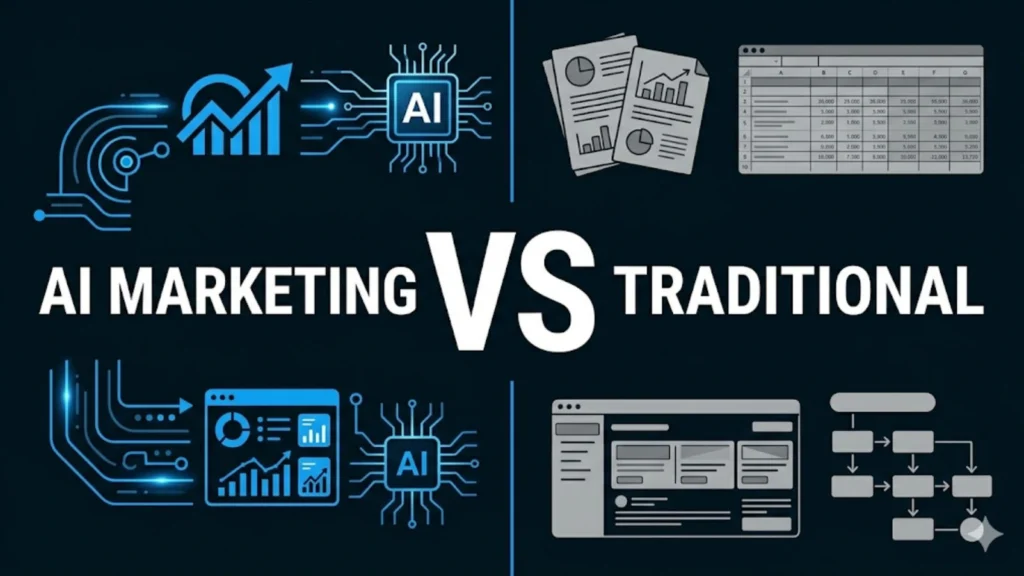
Here is the practical comparison of AI marketing vs traditional digital marketing.
Speed
Traditional digital marketing:
Slower because research, copywriting, optimization, reporting, and testing are mostly manual.
AI marketing:
Faster because AI can generate drafts, identify patterns, and automate repetitive actions.
Winner: AI marketing
If speed matters, AI has the edge.
Personalization
Traditional digital marketing:
Works with segment-based personalization, but usually at limited scale.
AI marketing:
Handles more dynamic personalization across more user groups and behaviors.
Winner: AI marketing
AI makes advanced personalization more realistic for growing businesses.
Cost Efficiency
Traditional digital marketing:
Higher human effort means higher time cost. Agencies or in-house teams usually need more people as output grows.
AI marketing:
Can reduce production cost and improve efficiency, especially for content, reporting, testing, and campaign support.
Winner: AI marketing, with a condition
AI reduces operating friction, but bad AI usage can also create waste. Cheap output is useless if quality drops.
Scalability
Traditional digital marketing:
Scaling usually means hiring more people, adding management layers, and expanding production systems.
AI marketing:
Scaling is easier because AI helps teams produce more without matching headcount growth.
Winner: AI marketing
A lean team can now execute at a level that previously needed a much larger team.
Human Control
Traditional digital marketing:
Humans control messaging, brand tone, strategic decisions, and optimization more directly.
AI marketing:
AI can assist or automate, but overdependence can reduce quality control if humans stop thinking critically.
Winner: Traditional digital marketing
When nuance, positioning, emotional intelligence, or brand judgment matters, human control is still stronger.
Creativity and Brand Judgment
Traditional digital marketing:
Original thinking is usually better because humans understand context, emotion, timing, and market psychology better.
AI marketing:
AI is strong at remixing patterns, but weaker at creating a truly differentiated brand stance on its own.
Winner: Traditional digital marketing
AI can support creativity. It should not define it alone.
Decision-Making
Traditional digital marketing:
Humans make slower but often more context-aware decisions.
AI marketing:
AI helps with faster suggestions and model-based decisions, especially in data-heavy environments.
Winner: It depends
For repetitive, data-heavy decisions, AI wins. For strategic decisions with real business risk, humans win.
Is AI Marketing a Replacement or a Support Layer?
For most businesses, AI is not a full replacement.
It is an upgrade layer.
That means:
- AI handles speed
- AI supports scale
- AI improves efficiency
- humans handle direction
- humans protect quality
- humans make final strategic decisions
The smartest model is not AI-only or human-only.
It is human-led, AI-assisted marketing.
That setup gives you:
- faster execution
- more testing capacity
- lower production friction
- better reporting support
- stronger strategic control
This is why the question “AI marketing vs traditional digital marketing” should really become: how should AI fit into my marketing system?
Where Human Strategy Still Wins
AI is useful, but there are areas where human marketers still outperform automation.
Brand Positioning
AI can generate messaging variations, but it cannot define what a brand should stand for unless a human defines it first.
Market Judgment
AI can analyze patterns. It cannot fully understand political sensitivity, cultural nuance, reputation risk, or category-specific psychology the way experienced marketers can.
Creative Direction
AI can create options. Humans decide which idea is actually right for the audience, timing, and business goal.
Offer Strategy
A marketer decides:
- what to sell
- to whom
- at what price
- with what promise
- through what funnel
AI can assist. It should not lead these decisions blindly.
Trust-Based Communication
High-ticket services, premium consulting, founder-led brands, and authority businesses still need a human voice. Buyers can often feel the difference between content that is processed and content that is actually understood.
Best Use Cases for Each
The right choice depends on the work.
Best Use Cases for Traditional Digital Marketing
Traditional digital marketing is better when:
- brand positioning is still being defined
- the campaign needs strong human storytelling
- the audience is niche and nuance matters
- the offer is high-ticket or relationship-driven
- the business needs manual oversight
- mistakes are expensive
Examples:
- premium consulting funnels
- founder-led personal brands
- B2B service positioning
- sensitive industry campaigns
- custom GTM strategy development
Best Use Cases for AI Marketing
AI marketing is better when:
- speed matters
- output volume is high
- testing is constant
- workflows are repetitive
- personalization needs to scale
- lean teams need leverage
Examples:
- ad copy variation generation
- email sequence drafting
- content ideation and outlining
- audience clustering
- reporting summaries
- product recommendation logic
- campaign optimization support
- chatbot-led lead qualification
Best Use Cases for a Hybrid Model
For most businesses, this is the strongest setup.
Use AI for:
- research support
- first drafts
- data analysis
- testing velocity
- automation
- scaling repetitive tasks
Use humans for:
- strategy
- positioning
- funnel logic
- creative judgment
- brand voice
- final review
This hybrid model gives the best balance of speed and control.
Final Verdict
AI marketing is not a replacement for digital marketing.
It is the next operating layer inside digital marketing.
Traditional digital marketing still matters because channels, strategy, audience psychology, and conversion principles do not disappear just because AI entered the picture. What changes is the speed, depth, and scale at which marketers can work.
So if you are asking whether AI marketing vs traditional digital marketing is an either-or choice, the answer is no.
AI is the upgrade.
Digital marketing is still the system.
Human strategy is still the control center.
Businesses that win will not be the ones blindly replacing marketers with tools. They will be the ones combining AI efficiency with human decision-making.
Actionable Takeaways
Here is what to do based on your current stage.
If you are a solo marketer or small business
Use AI to speed up:
- research
- content briefs
- ad copy drafts
- email drafts
- reporting summaries
But review everything manually.
If you run an agency or in-house team
Build AI into production and reporting workflows, not into final strategic authority. Let AI reduce execution time so your team can focus on revenue-driving decisions.
If you are still learning marketing
Do not use AI as a shortcut to avoid learning fundamentals. First understand audience, offer, funnel, messaging, and conversion logic. Then use AI to move faster.
If your brand depends on trust
Keep the final voice human. AI can help structure content, but authority comes from judgment, not just output.
Conclusion
The difference between AI marketing and traditional digital marketing is not about old vs new. It is about manual work vs leverage.
Traditional digital marketing gives more direct control. AI marketing gives more speed, efficiency, and scale. The strongest approach is not choosing one side. It is knowing where each one performs best.
Use AI to reduce friction. Use humans to drive direction. That is the practical answer.
Frequently Asked Questions
What is the difference between AI marketing and digital marketing?
Digital marketing refers to the channels and tactics used to promote products or services online, such as SEO, paid ads, email, and social media. AI marketing uses artificial intelligence to improve how those tactics are executed through automation, personalization, analysis, and faster content production.
Is AI marketing replacing traditional digital marketing?
No. AI marketing is not replacing digital marketing. It is improving it. Most businesses still need human strategy, creative judgment, and brand direction. AI works best as a support and scale layer.
Which is better for small businesses: AI marketing or traditional digital marketing?
Small businesses usually benefit most from a hybrid model. Use traditional digital marketing for strategic direction and AI for faster execution, lower production cost, and workflow efficiency.
Where does human strategy still matter in AI marketing?
Human strategy still matters in brand positioning, offer creation, audience psychology, creative direction, and final decision-making. AI can support these areas, but it should not control them blindly.
Can AI improve personalization in digital marketing?
Yes. AI can help marketers create more tailored messaging based on behavior, intent, and engagement patterns. This makes personalization more scalable than manual segmentation alone.