AI agents are everywhere right now.
Every AI tool claims to automate marketing. Every founder demo makes it sound like prompts can replace execution. Every marketer is hearing the same message: autonomous systems are the future.
That is exactly why this topic needs clarity.
Agentic AI in marketing is not the same as basic automation. It is also not some magic layer that can run your entire growth engine without mistakes. In practical terms, it sits in the middle. It can handle multi-step tasks, make limited decisions, respond to changing inputs, and move work forward with less human intervention than normal tools. But it still has clear limits.
If you are a founder, marketer, freelancer, or operator trying to separate what is real from what is hype, this is what matters: agentic AI can be useful, but only inside the right workflows. Used blindly, it creates noise, errors, and false confidence.
What Is Agentic AI in Marketing?
Agentic AI in marketing refers to AI systems that do more than generate outputs on command.
A normal AI tool usually waits for you to ask for something. You type a prompt, and it gives you a result. End of task.
An agentic system works differently. It can take a goal, break it into steps, interact with tools or data sources, evaluate what happened, and decide what to do next within a defined scope.
In marketing, that could mean an AI system that:
- pulls campaign data from multiple sources
- spots performance changes
- compares results against targets
- flags problems
- recommends actions
- triggers the next workflow automatically
That is why people also use terms like autonomous AI marketing, AI agents for marketers, and agentic marketing workflows.
But the key word is not autonomous. The key word is bounded.
Good agentic systems do not run marketing like a human CMO. They operate within rules, access, context, and constraints set by humans.
Read More:- How to Start an AI Marketing Agency in 2026
Agentic AI vs Marketing Automation: What’s the Real Difference?
This is where most confusion starts.
Traditional marketing automation follows predefined rules.
For example:
- if someone fills a form, send email A
- if they do not open, send email B after 2 days
- if lead score crosses a threshold, notify sales
That is automation. It is useful, but rigid.
Agentic AI adds a layer of reasoning and adaptation.
Instead of only following fixed rules, it can:
- interpret inputs
- decide between multiple paths
- generate custom outputs
- use feedback to adjust the next step
- coordinate across tasks and tools
So the difference is simple:
Marketing automation executes workflows.
Agentic AI can interpret situations inside workflows.
That sounds powerful, and it is. But it also creates more room for mistakes.
A rule-based automation usually fails in predictable ways. An agentic system can fail in less obvious ways because it is making judgments based on incomplete or messy inputs.
That is why marketers should stop asking, “Can this run on autopilot?” and start asking, “What level of judgment is safe to delegate?”
Why Marketers Are Suddenly Talking About AI Agents
The interest is not random.
Three things changed.
1. AI outputs got better
Language models became good enough to handle real marketing tasks like summarizing research, drafting copy, categorizing leads, and explaining performance changes.
2. Tool integration improved
AI is no longer stuck inside chat windows. It can now connect with CRMs, ad platforms, spreadsheets, analytics dashboards, email tools, and internal systems.
3. Teams want leverage
Most marketing teams are overloaded. Small teams want more output without more headcount. Large teams want faster coordination and less manual reporting overhead.
That is why AI marketing automation 2026 conversations are shifting toward agents. People no longer want content generation alone. They want AI that can move work across systems.
The demand makes sense.
The hype is where things go wrong.
Read More:- AI Marketing in 2026: Complete Business Guide to Strategy, SEO, Content, and Ads
Where Agentic AI Actually Helps in Marketing
This is the part marketers care about most.
Agentic AI is useful when the work is:
- repetitive but not fully fixed
- dependent on multiple inputs
- time-sensitive
- easy to verify after execution
- expensive to do manually at scale
That means some areas are a better fit than others.
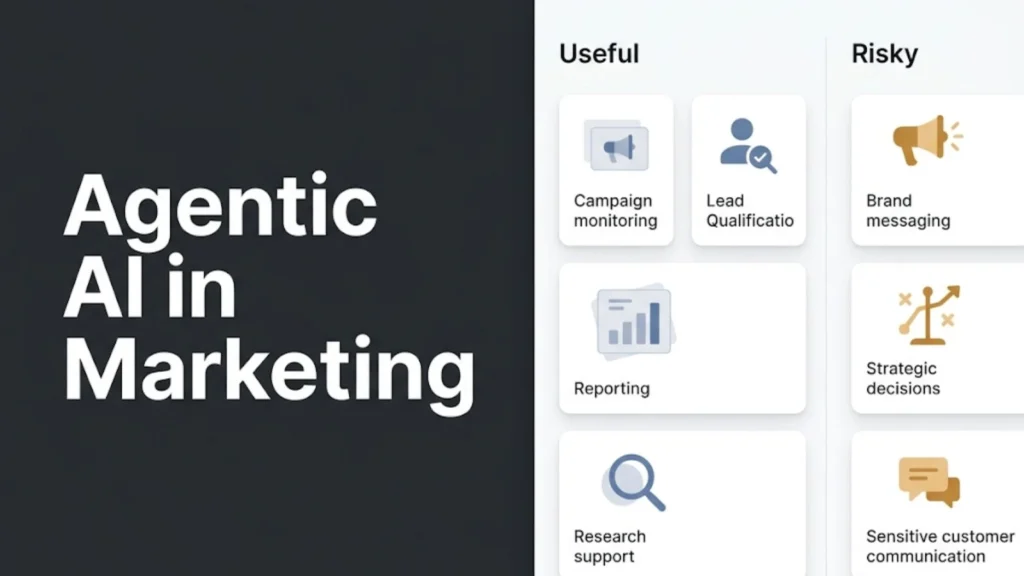
Content Research and Briefing
This is one of the strongest use cases.
An AI agent can:
- collect SERP patterns
- summarize competitor pages
- extract recurring subtopics
- group keyword themes
- identify content gaps
- turn findings into a working brief
That saves time because the agent is not just writing. It is helping with the prep work before writing starts.
This is especially useful for:
- SEO content planning
- topic clustering
- content brief creation
- repurposing source material into channel-specific formats
But there is a catch.
AI can organize information well. It still struggles to judge originality, business relevance, and strategic priority at a high level. It may create a clean brief that is still based on weak assumptions.
So yes, agentic AI helps in research and briefing. No, it should not be the final strategic brain.
Campaign Monitoring and Optimization
This is another strong use case, especially for paid media and performance teams.
An agentic workflow can monitor:
- spend spikes
- CTR drops
- CPA jumps
- conversion rate changes
- keyword waste
- budget pacing issues
- creative fatigue signals
It can then:
- send alerts
- summarize likely causes
- suggest actions
- prepare draft changes for review
In some cases, it can also execute bounded actions automatically, like pausing low-quality placements or shifting budget within strict guardrails.
This is where AI agents in digital marketing become genuinely useful.
Why? Because campaign monitoring is ongoing, data-heavy, and often delayed by human bandwidth.
Still, full autonomy is risky.
Performance data is messy. Attribution is imperfect. A short-term signal can be misleading. If the agent reacts too fast or optimizes for the wrong KPI, it can make the account worse.
So the practical model is not full autopilot. It is AI for monitoring, diagnosis, and recommendation with controlled execution.
Read More:- AI Marketing Workflow for Small Businesses
Lead Qualification and Follow-Up Workflows
This is where people get excited fast, and sometimes for good reason.
An AI agent can:
- read inbound form submissions
- classify lead quality
- enrich data from internal records
- route leads to the right pipeline
- draft follow-up messages
- personalize sequences based on context
- trigger reminders when a lead goes cold
For small teams, this can remove a lot of manual work.
For agencies and service businesses, it can improve response speed, which directly affects conversion chances.
But this use case becomes risky when businesses assume AI understands intent better than it actually does.
Lead quality is not just about keywords in a form. Tone, context, timing, deal size, and business fit matter. AI can help with first-pass sorting, but weak qualification logic can push good leads away or waste time on bad ones.
This is a perfect example of where agentic AI should support human sales judgment, not replace it.
Reporting, Alerts, and Decision Support
Most teams waste too much time collecting numbers and too little time interpreting them.
Agentic workflows can improve that.
An AI agent can:
- pull data from dashboards
- compare week-over-week or month-over-month changes
- flag anomalies
- generate summaries for teams or clients
- identify likely reasons behind movement
- recommend where to investigate next
This is useful because reporting is usually repetitive, cross-platform, and time-consuming.
For agencies, this can reduce manual reporting load.
For founders, it can turn scattered metrics into readable summaries.
For operators, it can speed up weekly decision-making.
This is one of the cleanest use cases because the output is easy to review.
If the AI gets the summary wrong, a human can catch it before it turns into a bad decision. That makes it safer than areas where the agent directly affects customer experience or live campaign delivery.
Where Agentic AI Fails or Creates Risk
This is the part too many articles skip.
Agentic AI does not fail only because the model is weak. It fails because marketing itself is messy.
Here is where problems show up.
It confuses confidence with correctness
AI often sounds sure even when it is wrong. That becomes dangerous when teams start trusting fluent outputs more than actual evidence.
It lacks true business context
An agent may know campaign numbers, but not the politics, priorities, product issues, seasonality, or sales realities behind them.
It can optimize for the wrong goal
If the system is told to maximize one metric without the right constraints, it may improve the number while hurting actual business outcomes.
It breaks in edge cases
Messy CRM data, bad attribution, unusual audience behavior, broken tracking, or inconsistent naming conventions can all distort the agent’s decisions.
It can create scale without quality
An AI system can produce more emails, more reports, more briefs, and more actions. That does not mean it is creating better marketing.
This is where autonomous AI marketing gets oversold.
Scale is easy. Good judgment is not.
Read More:- AI Marketing vs Traditional Digital Marketing: What Actually Changes?
Why Human Review Still Matters
Human review still matters because marketing is not just execution.
It is prioritization. It is trade-offs. It is context. It is understanding what should happen, not just what can happen.
Humans are still better at:
- judging brand risk
- spotting hidden context
- understanding market nuance
- making trade-offs across channels
- deciding when not to act
- questioning whether the system is solving the right problem
AI is strong when the task is clear.
Humans are essential when the task is ambiguous.
That is why the best agentic marketing workflows are not built around replacing people. They are built around reducing low-value work while keeping high-impact judgment human.
Best Use Cases for Small Teams vs Large Teams
The same agentic setup does not fit every team.
Small teams
Small teams should focus on leverage.
Best use cases:
- content research and brief creation
- lead routing and first-response drafting
- reporting summaries
- campaign anomaly alerts
- internal knowledge organization
The goal is simple: remove repetitive work and increase speed.
Small teams usually do not need complex multi-agent systems. They need a few practical workflows that save real time.
Large teams
Large teams benefit more from coordination and consistency.
Best use cases:
- cross-channel reporting
- workflow orchestration across departments
- QA support
- standardized brief generation
- alert systems for spend, pacing, and performance deviations
- internal decision-support systems
The main advantage here is not just time savings. It is operational control.
Larger teams can use agentic AI to reduce bottlenecks, improve response time, and keep systems more consistent across many people and channels.
Read More:- Claude AI for Marketers: 7 Practical Workflows That Save Hours Every Week
Should You Use Agentic AI in Marketing Right Now?
Yes, but with the right expectations.
Do not adopt it because the market is obsessed with AI agents.
Do not adopt it because a tool demo looked impressive.
Do not adopt it because you want “full autopilot marketing.”
Use it if you have workflows that are:
- repeated often
- slowed by manual coordination
- based on structured inputs
- easy to review
- expensive to ignore
Start where mistakes are visible and reversible.
That means:
- research
- reporting
- monitoring
- workflow routing
- bounded optimization support
Avoid handing full control to AI in areas where bad decisions directly affect brand, customer trust, positioning, or budget without review.
The smartest marketers in 2026 will not be the ones who automate everything.
They will be the ones who know what to automate, what to supervise, and what should stay human.
Practical Takeaways: What to Do
If you want to use agentic AI in marketing without getting trapped by hype, follow this approach:
- start with one workflow, not ten
- choose a workflow that is repetitive and easy to review
- define clear success metrics
- set limits on what the AI can do automatically
- keep a human approval layer where business judgment matters
- fix your data quality before adding autonomy
- measure whether it saves time, improves output, or reduces mistakes
The real win is not using AI agents.
The real win is building systems that make your marketing operation sharper, faster, and more reliable.
Conclusion
Agentic AI in marketing is real, but most people are still talking about it too loosely.
It is not the same as traditional automation. It is not a magic replacement for marketers either. Its actual value comes from handling multi-step, semi-structured work that benefits from speed, pattern recognition, and tool coordination.
That makes it genuinely useful in content research, campaign monitoring, lead workflows, and reporting support.
It also makes it risky when businesses expect it to think like an experienced marketer, operator, or strategist.
The practical path is simple: use agentic AI where the upside is real, the boundaries are clear, and human oversight stays in place.
That is how smart teams will use AI. Not as a fantasy. As infrastructure.
FAQs
1. What is agentic AI in marketing?
Agentic AI in marketing refers to AI systems that can handle multi-step marketing tasks, make limited decisions, and move work forward within defined boundaries.
2. How is agentic AI different from marketing automation?
Marketing automation follows fixed rules. Agentic AI can interpret inputs, adapt its path, and generate actions inside a workflow.
3. Should small businesses use AI agents for marketing?
Yes, but only in bounded, reviewable workflows like research, reporting, lead routing, and monitoring. Small businesses should not chase full autopilot.