ChatGPT getting better at product discovery is not a cute UX update. It is a signal that product research is moving into conversational interfaces where the model does more of the filtering, comparison, and narrowing before the click even happens. That changes who gets seen, how products get chosen, and what “visibility” now means for brands, publishers, and affiliate-style content businesses.
What this signal is really about
This signal is really about one thing: product discovery is becoming model-mediated.
For years, product discovery mostly looked like this: search query, list of links, category page, review article, comparison page, retailer, maybe YouTube, maybe Reddit, then decision. ChatGPT is pushing a different flow: describe the need, refine in conversation, compare inside the interface, narrow the options faster, then move to a merchant. That is a different acquisition environment.
That matters because once the interface starts doing more of the comparison work, a lot of traditional discovery mechanics lose power. The user may never open ten tabs. They may never read five “best X” articles. They may never even see the broad category SERP the way they used to. The model compresses the research layer. That is the real shift.
What happened
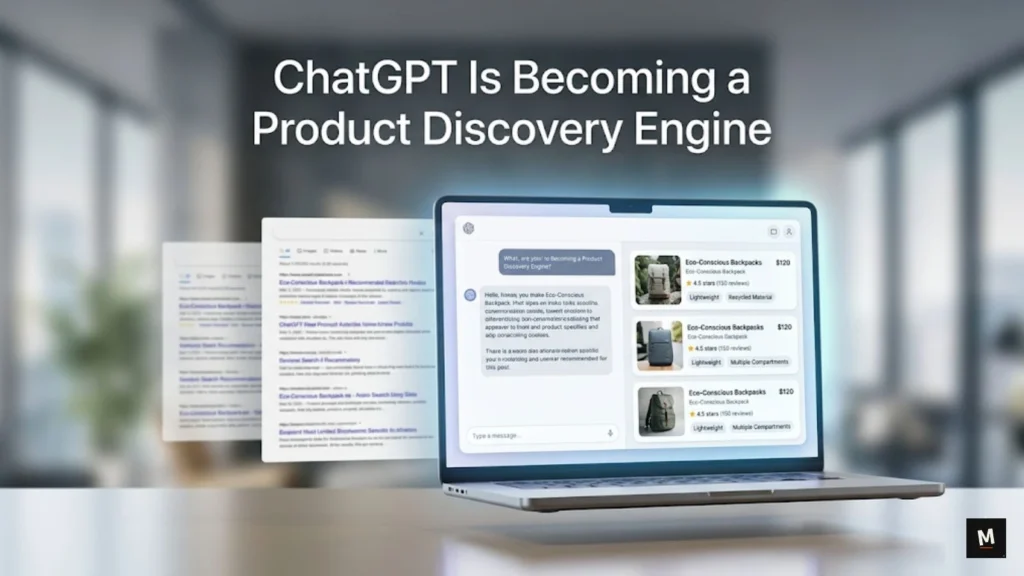
OpenAI announced on March 24, 2026 that it is making ChatGPT shopping more visual and more useful for discovery, with better browsing, side-by-side comparison, image-based product matching, and more up-to-date product information. OpenAI said these improvements are powered by an expanded Agentic Commerce Protocol (ACP) and are rolling out across Free, Go, Plus, and Pro users.
You can read the official update here: OpenAI product discovery update
OpenAI also said merchants can feed product data and promotions into this layer through ACP, including through integrations with providers like Salesforce and Stripe. It named retailers such as Target, Sephora, Nordstrom, Lowe’s, Best Buy, The Home Depot, and Wayfair as already integrated for discovery, and said Shopify catalog data is already integrated for Shopify merchants.
This builds on the earlier shopping direction OpenAI had already started. Reuters reported in April 2025 that ChatGPT shopping recommendations included images, reviews, direct purchase links, and were positioned as non-ad-driven recommendations based on third-party structured metadata like prices, product descriptions, and reviews.
Coverage here: Reuters on ChatGPT shopping
Why this matters now
It matters now because ChatGPT is no longer just helping users understand things. It is helping them decide what to buy.
That is a different level of commercial intent. A user asking for the best standing desk for a small apartment, or a dress similar to an uploaded image, is much closer to a transaction than someone casually reading a blog post. OpenAI is clearly optimizing for discovery, comparison, narrowing, and merchant handoff.
It also matters because OpenAI is not framing this as a one-off feature. It is framing ACP as part of a foundation for AI-native commerce, with future directions like personalization, local availability, and ETAs. That means this is not just about nicer product cards today. It points to a larger system where AI interfaces become a meaningful entry point into commerce.
And it matters because AI-driven discovery sits inside a broader visibility shift. If you have already seen how answer surfaces are changing search behavior, this connects naturally with AI visibility and answer-layer discoverability.
Related read: AI Overviews for marketers and content teams
What most people will get wrong
They will treat this like just another traffic channel
That is too shallow.
This is not just “another place to get clicks from.” This is a system where the consideration set itself gets compressed earlier. If the model gives the user three strong options, the rest of the market is invisible. The old logic of “just rank somewhere on page one and get a chance” gets weaker in these flows.
They will think this only matters for ecommerce giants
Wrong again.
Yes, large merchants with direct integrations have an advantage. But smaller brands can still win if their product data is clean, their merchant presence is strong, their reviews are credible, and their products are described in ways that map to real buying constraints. Completeness, relevance, freshness, and merchant-fed product information matter here, not just brand size.
They will think SEO is dead, so none of this matters
Lazy take.
This is not “SEO is dead.” This is discovery is fragmenting. Visibility is spreading across traditional search, AI interfaces, merchant feeds, structured product information, publisher mentions, and recommendation systems. SEO still matters, but plain old “rank a keyword and wait” is not enough for product-led categories anymore.
The deeper shift behind this signal
The deeper shift is that the interface is becoming the evaluator.
In traditional search, the engine mostly helped you find sources. In this model, the assistant increasingly helps you interpret, shortlist, compare, and decide. The user’s work decreases. The model’s role increases. That changes what content and data are valuable.
The winners in this environment are not automatically the loudest brands. They are the brands, merchants, and publishers whose information is easiest for machines to interpret and trust: clean specs, current pricing, reliable reviews, clear differentiation, structured catalogs, merchant integrations, and content that actually answers buying questions instead of padding word count.
This also means design-heavy persuasion can lose relative power in the earliest discovery phase. If the shortlist is created before the user lands on your site, then your product page may be defending a decision more than creating it. The persuasion window shifts upstream into data quality, recommendation inclusion, and comparative clarity.
What this means for marketers, founders, and operators
For marketers
You now need to think beyond search rankings and paid placements. You need to ask: when an AI system helps a user compare products in my category, do I have the inputs needed to show up well?
That means product feed quality, consistent naming, reliable specs, review visibility, merchant data hygiene, and category-level comparison clarity become marketing concerns, not just ecommerce ops issues.
This also connects with a larger shift in how marketers should think about AI systems inside workflows.
Related read: Agentic AI in marketing
For founders
If you sell a physical product, this is a board-level signal, not a tactic-level curiosity.
The buying journey is getting shorter and more mediated. If AI interfaces become a serious discovery layer, then “are we included in the recommendation environment?” becomes a commercial question. Brands that ignore this may not immediately see a crash, but they risk losing inclusion at the top of the funnel while still staring at normal-looking analytics elsewhere.
For operators
This is where the real work sits.
Someone has to own the messy layer: product schema, feed accuracy, attribute completeness, review sources, merchant center consistency, catalog health, on-page comparison readiness, and partner or distribution coverage. Discovery quality is increasingly being tied to structured merchant inputs and compatible systems, not just better ad copy or prettier landing pages.
If you are building broader systems around AI-assisted acquisition and workflow clarity, this piece also pairs well with: AI marketing guide
What should be audited, changed, or tested now
Audit product data like it affects acquisition
Because now it does.
Check whether your titles, descriptions, specs, variants, pricing, availability, and category labels are consistent across your store, feeds, marketplaces, and partner systems. If the machine sees fragmented inputs, your visibility quality drops.
Rework content for buying questions, not just keywords
A lot of affiliate and commerce content is bloated because it was built to win SERPs, not to help a machine build confidence.
That needs to change. Build pages that make comparison easier: who this is for, who it is not for, budget band, tradeoffs, alternatives, use-case fit, material or spec details, and realistic pros and cons. If AI systems are synthesizing, weak fluff content loses even harder.
Track AI referral and assisted discovery separately
Do not dump this into a vague “organic” bucket and move on.
Create a reporting layer for AI-origin discovery, branded query lift after AI exposure, higher-intent sessions from comparison-style content, and conversion behavior from users who arrive already narrowed. Even if direct attribution is imperfect, you need directional visibility before this channel becomes too big to ignore.
Test inclusion, not just ranking
Start running live category prompts in ChatGPT for your product space.
See which brands appear. See what attributes are repeated. See whether the model understands your product positioning correctly. See what competing products consistently enter the shortlist. That is not a replacement for SEO research. It is now part of it.
Publishers and affiliate-style sites need to get sharper
The lazy model of “10 best products” pages stuffed with recycled talking points gets weaker in a world where the assistant already does first-pass comparison.
What still has value is original testing, category judgment, strong recommendation logic, real tradeoff analysis, and content that adds confidence rather than noise.
Final takeaway
ChatGPT becoming a product-discovery surface is not just an OpenAI story. It is a market signal.
The signal says discovery is getting more conversational, more compressed, more structured, and more dependent on machine-readable trust. The old web journey is not disappearing overnight, but the first layer of comparison is moving closer to the model. That means marketers need to think about AI visibility, not just search visibility. Founders need to treat recommendation inclusion like a growth risk. Operators need to clean the data layer that most teams still ignore.
The mistake is to see this as “shopping inside ChatGPT.” The smarter read is this: the interface that helps people decide what to buy is changing, and the brands that prepare for that shift early will not have to panic later.